Jump to a section (10)
- 01How to tell a tick from a bed bug at a glance
- 02Where did you find it?
- 03Do bed bugs latch on like ticks?
- 04Will a shower get rid of bed bugs?
- 05Are bed bugs active during the day?
- 06Is a tick or a bed bug more dangerous?
- 07What kills 100% of bed bugs?
- 08Safe checks you can do at home
- 09When to call a professional
- 10How Waves Pest Control approaches it
You found a small bug, and now you need to know if it is a tick or a bed bug. Maybe it was on your ankle after you edged the St. Augustine, or maybe it was on the pillowcase this morning. Both can be small, flat and brown before they feed, and both swell up after a meal, so the mix-up is easy to make. This guide shows you how to tell them apart and what to do next in a Southwest Florida home. For everything a visit can cover, see our pest control services page.
How to tell a tick from a bed bug at a glance
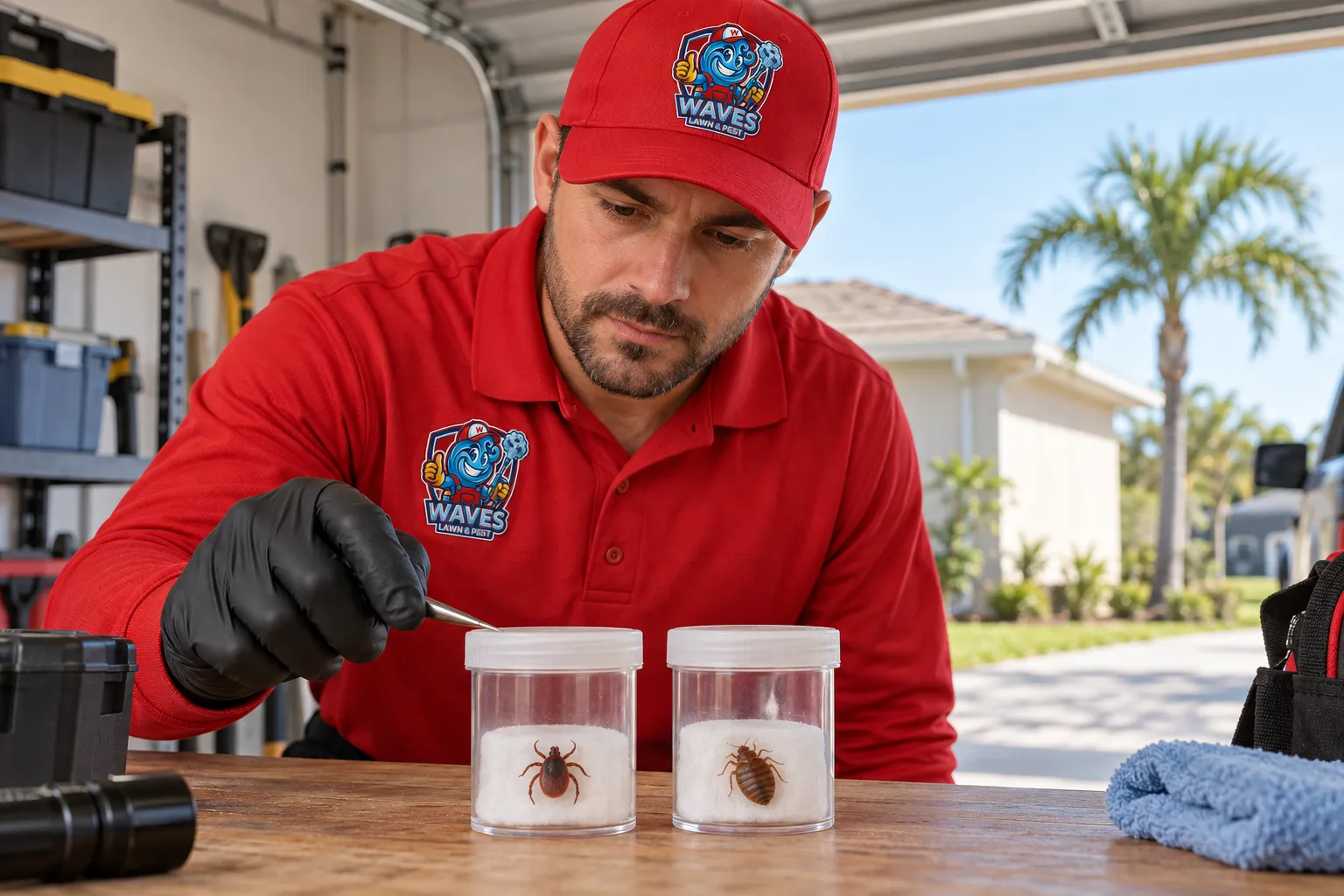
Count the legs first. UF/IFAS says ticks are not insects: they have eight legs and no segmented abdomen, which makes them arachnids, close relatives of spiders and mites (UF/IFAS Pest Alert). The EPA’s bed bug identification card describes a bed bug as oval shaped and flattened, with six legs.
There is one catch. Very young ticks have six legs too. UF/IFAS describes the American dog tick moving from a 6-legged larva to an 8-legged nymph and then the adult, and it puts the larva at about 0.62 mm long (UF/IFAS EDIS). A six-legged bug the size of an apple seed is far bigger than that.
Other clues to check with a magnifying glass or a phone camera:
- Size and color. The EPA says an adult bed bug is about the size of an apple seed, 5 to 7 mm (3/16 to 1/4 inch) long. It is brown and flat when it has not fed, and reddish-brown, balloon-like and more elongated after a meal (EPA).
- The swollen look. A feeding tick can grow far bigger than a bed bug. UF/IFAS says a female brown dog tick increases its body size a hundred-fold while it feeds, reaching the size of a raisin (UF/IFAS EDIS).
These are clues, and a clear look at the bug confirms it. If the bites came from the yard and you never saw a bug, our guide to chigger bites vs bed bug bites may help.
Found a bug in the bedroom and want a second set of eyes? Get a pest control estimate and have a technician confirm what it is.
Pro tip: Save the bug before you do anything else. The EPA card says to capture a bed bug in a clear zip bag for proper ID. The CDC says to put a removed tick in a sealed container or wrap it tightly in tape, and never to crush it with your fingers. A sharp photo and a note of the exact spot help whoever identifies it.
Where did you find it?
The spot where you found the bug narrows it down fast, because ticks and bed bugs live in different places.
- On you after time outside. The CDC says ticks live in grassy, brushy or wooded areas, or on animals, and that many people pick up ticks in their own yard or neighborhood (CDC). UF/IFAS describes adult American dog ticks climbing onto a grass blade or other low plant and grabbing onto an animal that brushes past.
- In or near the bed. The CDC says bed bugs hide during the day on or around the bed and tend to live within 8 feet of where people sleep (CDC). The EPA card points to headboards, mattress seams, box springs, baseboards and other furniture.
- Near the dog bed or crawling up a wall. This is where the mix-up happens. UF/IFAS says the brown dog tick is unusual because it can finish its whole life cycle indoors. Owners often see these ticks on furniture, baseboards, carpeting and dog bedding, or crawling up walls and curtains. UF/IFAS adds that in Florida the cycle can run year-round inside homes.
So a reddish-brown bug near the dog’s favorite spot in a Sarasota or Bradenton living room may be a tick, even indoors.
Do bed bugs latch on like ticks?
No. A tick stays attached while it feeds, for days in the case of the American dog tick, and a bed bug feeds for minutes and then leaves.
UF/IFAS gives the American dog tick’s feeding times: larvae need 2 to 14 days to finish feeding, nymphs feed over 3 to 10 days, and an adult female engorges within 6 to 13 days. A bed bug works differently. The Virginia Tech bed bug biology guide (VDACS) says a bed bug probes the skin, feeds for 5 to 10 minutes, then leaves and returns to a crack or crevice. UF/IFAS adds that bed bugs lack body parts that let them cling to hair or fur, so they are rarely found on people or animals (UF/IFAS EDIS).
That gives you a clue. A bug still attached to your skin points to a tick. A bug loose on the sheets, or a row of itchy welts with no bug in sight, points toward bed bugs. The CDC says bed bug bite marks may be random or appear in a straight line, and they can take as long as 14 days to show up in some people.
Will a shower get rid of bed bugs?
No. Bed bugs live in your bed and furniture, so a shower does nothing about them. The CDC says they hide on or around the bed, and UF/IFAS says they are rarely found on their hosts.
A shower does help with ticks. The CDC says showering soon after you come indoors has been shown to lower the risk of Lyme disease, may help with other tickborne diseases, and may wash off ticks that have not attached yet. It is also a good time for a tick check, and the CDC says a hot clothes dryer kills ticks on dry clothing.
Are bed bugs active during the day?
Mostly no. UF/IFAS says bed bugs are usually active only at night but will feed during the day when hungry. The Virginia Tech guide puts their peak between midnight and 5:00 a.m., when people are in their deepest sleep. Seeing one in daylight does not rule out bed bugs.
For ticks, the CDC says to do a full body check after time in tick areas, including your own backyard.
Is a tick or a bed bug more dangerous?
A tick. The CDC says bed bugs are not known to spread diseases to people. Ticks can. UF/IFAS says five species of hard ticks are the ones Floridians are most likely to meet, and it links them to diseases such as Lyme disease and spotted fevers.
If you find a tick attached, follow the CDC’s steps after a tick bite:
- Grasp the tick as close to the skin as possible with clean fine-tipped tweezers.
- Pull it away with steady, even pressure. Do not twist or jerk it, which can leave the mouthparts in the skin.
- Clean the bite and your hands with soap and water, rubbing alcohol or hand sanitizer.
- Put the tick in a sealed container, wrap it tightly in tape, flush it or put it in alcohol.
The CDC says to see your doctor if you get a rash or fever within several weeks of removing a tick, and to tell the doctor when and where you got the bite.
For bed bug bites, the CDC says the bites can itch, and to talk with your healthcare provider if you think you are having an allergic reaction. If any bite is followed by trouble breathing, swelling of the face or mouth, trouble swallowing, chest pain, or fainting, get emergency care right away. MedlinePlus lists those among the signs of a severe allergic reaction to insect bites.
What kills 100% of bed bugs?
No single product or step can promise that. The EPA says treating bed bugs is complex and can take weeks to months, depending on how far the infestation has spread (EPA).
- Heat. UF/IFAS says temperatures above 113°F to 115°F kill every bed bug stage (UF/IFAS EDIS). The EPA says you can use a clothes dryer on high heat, but warns that do-it-yourself heat treatments might not work.
- Sprays. UF/IFAS says bed bugs can be very hard to kill with insecticides, and that eggs may not be affected by a spray, so a spray treatment needs a repeat round to reach newly hatched nymphs.
- Foggers. UF/IFAS cites a study that found over-the-counter foggers are not effective against bed bugs. The EPA says foggers should not be your only method of bed bug control.
Our guide to whether bleach can kill bed bugs covers the household-cleaner question in more detail.
Safe checks you can do at home
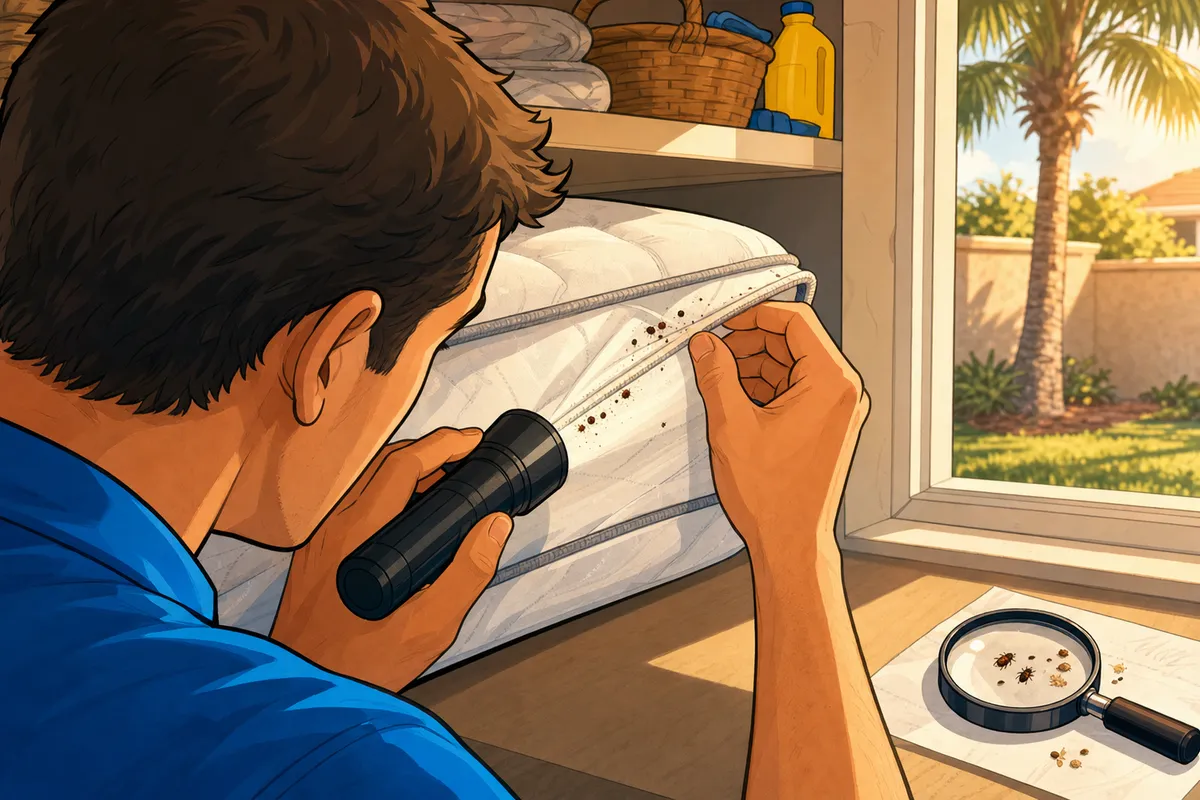
- Check the bed. The CDC says to look for shed skins, bugs in the folds of mattresses and sheets, rusty-colored blood spots, and a sweet musty odor. Start at the mattress seams and headboard and work outward.
- Check the dog. Look at the head, ears, back, between the toes and the armpit area, the brown dog tick’s favorite spots per UF/IFAS. Ask your veterinarian before you put any tick product on a pet.
- Cut the grass at the edges. The UF/IFAS guide to the American dog tick says keeping grass and weeds cut short lowers humidity and makes it harder for ticks to climb plants and wait for a host.
What not to do
- Don’t burn or smother a tick. The CDC says not to use petroleum jelly, heat, nail polish or other substances to make a tick let go.
- Don’t soak the mattress. UF/IFAS warns against soaking mattresses and upholstery with pesticides. If you use any product labeled for bed bugs or ticks, read and follow the product label, keep it off food-preparation and food-contact surfaces, and place it out of sight and reach of children and pets.
- Don’t move to the couch. UF/IFAS notes bed bugs can feed and live in couches and recliners too.
- Don’t panic and throw out furniture. The EPA card says not to, and to capture the bug for proper ID instead.
When to call a professional
Call a pro when you find a live bed bug, shed skins or blood spots, or when bites keep showing up and you cannot find the cause. The EPA says to hire a pest management professional if needed. For ticks indoors, UF/IFAS says a heavy brown dog tick infestation in a home calls for a professional pest control operator, and repeated treatment may be needed.
How Waves Pest Control approaches it
Our approach starts with identification, because a tick from the dog bed and a bed bug from the mattress need different plans. A first visit from Waves Pest Control includes a walk around the property to find active pest pressure. For bed bugs, Waves Pest Control offers both heat treatment and chemical treatment. Have your bagged bug, your photos and a list of the rooms where you found it ready when you ask for an estimate.
For year-round coverage of general household pests, look at our WaveGuard memberships. If the bites have you comparing more than two culprits, our guide to bed bug, flea and mite bites lays out the patterns.
If you think you have bed bugs in Sarasota, see our bed bug control in Sarasota page. In Manatee County, start with bed bug control in Bradenton. You can also browse the pest library or get a pest control estimate online.