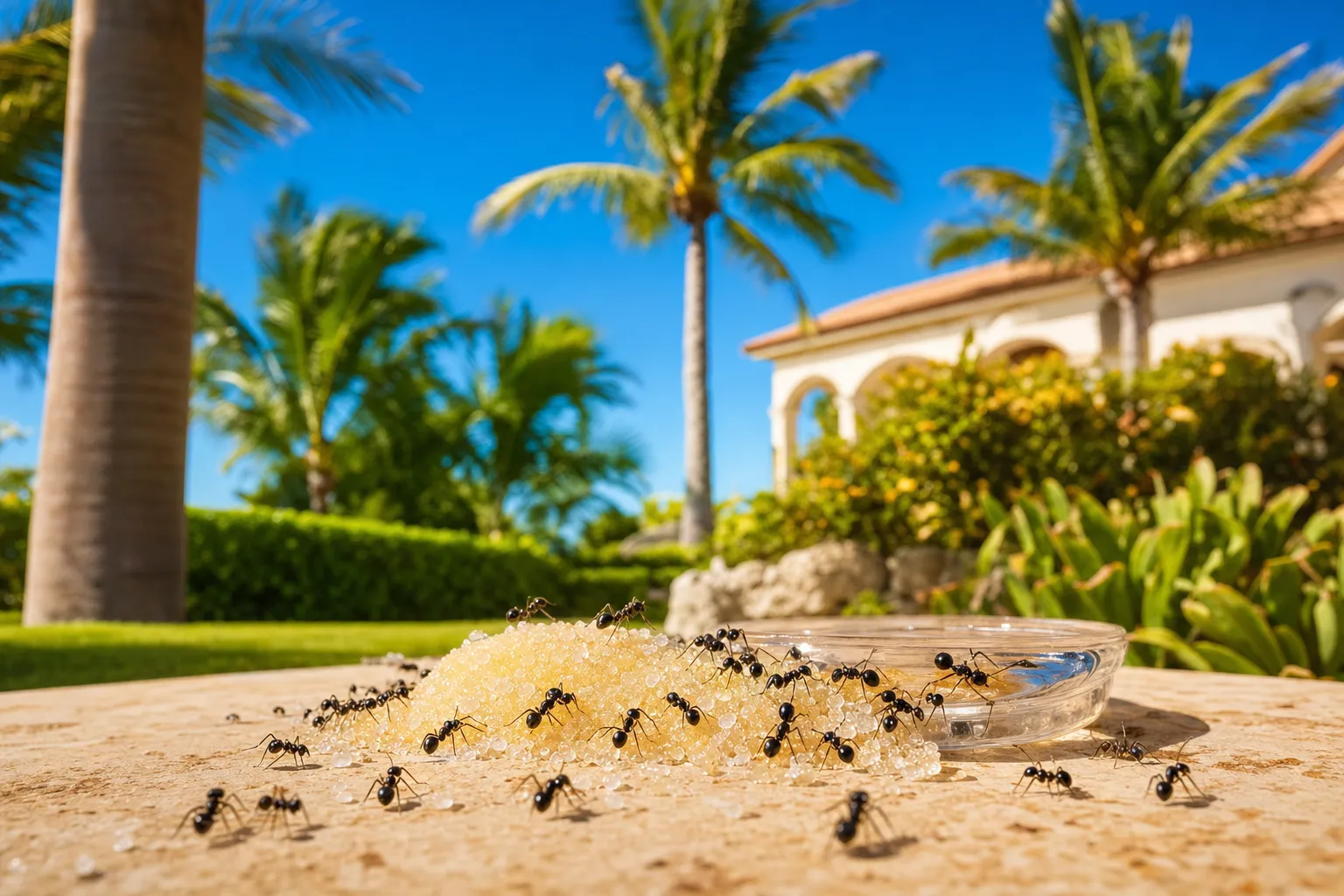
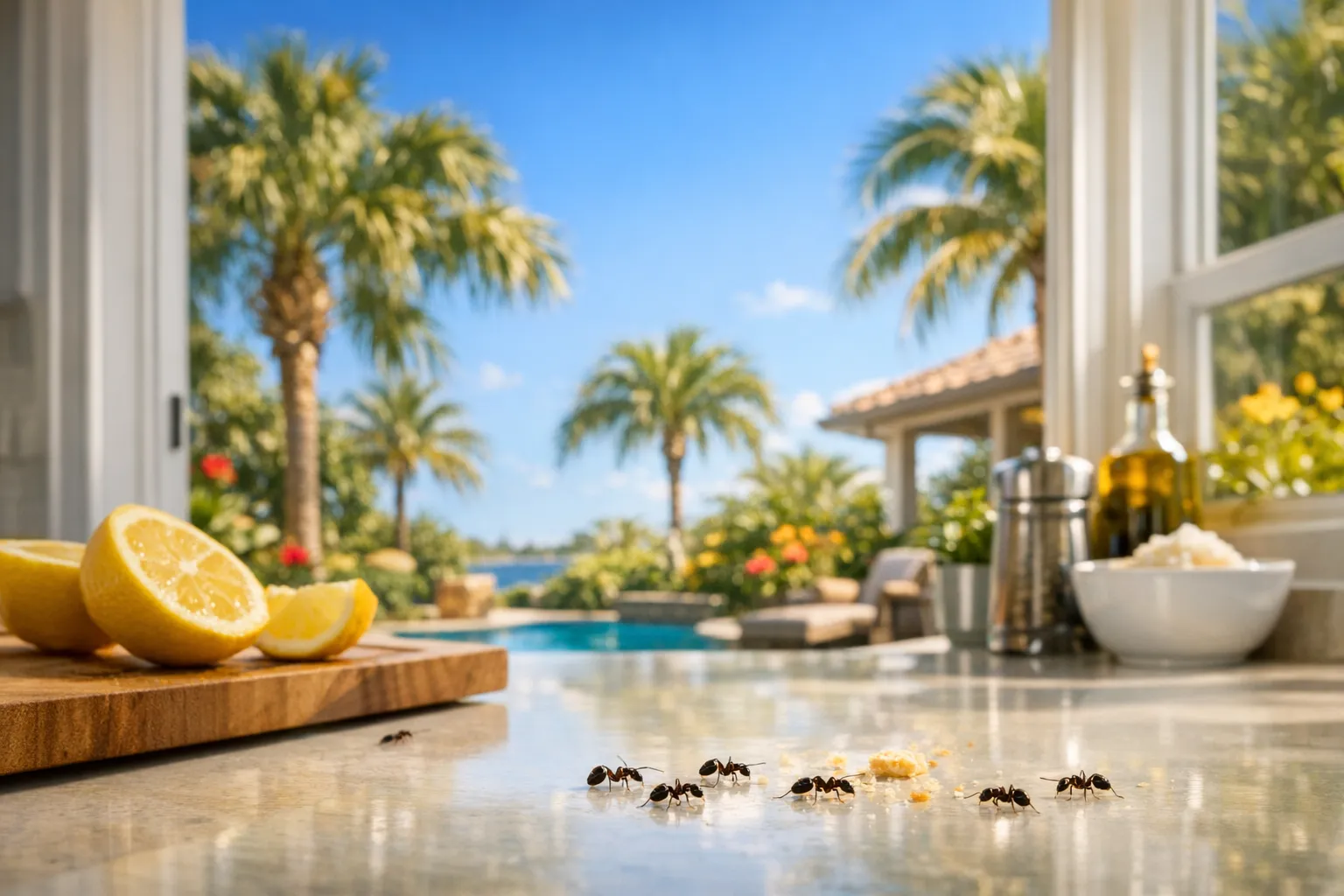
There’s a trail of pinhead-sized ants marching across your kitchen counter in Sarasota, Bradenton, or Cape Coral, and you’re one panic-Google away from buying whatever spray promises the fastest revenge. Slow down. In Southwest Florida, tiny kitchen ants are almost always one of three things — ghost ants, so-called “sugar ants,” or Pharaoh ants — and each one is a different problem with a different fix. Reach for the wrong can of anything and you can literally make the infestation worse. This is an identification-first guide, not a treatment plan; for the actual takedown, we point you back to our step-by-step get-rid-of posts and the full pest control services menu. Every measurement and behavior claim here is sourced to the University of Florida IFAS Featured Creatures profiles.
Not sure what you’re looking at and want a professional eye on it before you spray? Request a quote — we’ll ID the species before we treat.
The 10-second triage: where the trail is, what they’re eating, time of day
Before you get on your hands and knees with a magnifier, note three things:
- Where’s the trail? Countertops, sinks, and baseboards in kitchens or bathrooms are classic ghost-ant real estate — UF/IFAS notes ghost ants enter structures from nests near foundations or from plants contacting the building. Trails vanishing into wall outlets, plumbing penetrations, or the seam between the cabinet and the wall are the classic Pharaoh-ant tell — UF/IFAS documents them nesting in warm, humid, inaccessible spots near food and water, and using wiring or hot water pipes to travel through walls and between floors.
- What are they eating? A trail worshipping a spilled soda or the honey bear points toward ghost ants (or the catch-all “sugar ant”). A trail happy to work grease and sweets is more consistent with Pharaoh ants, which UF/IFAS notes are attracted to both sweet and fatty foods.
- How are they moving? Ghost ants on an established trail move slowly and deliberately; disturb them and they scatter erratically. Pharaoh ants tend to trail steadily, often along a heat source like a hot-water pipe.
Ghost ant ID (Tapinoma melanocephalum) — per UF/IFAS Featured Creatures
- Size: 1.3 to 1.5 mm long — smaller than a grain of rice. Workers are monomorphic (all one size).
- Color: dark brown head and thorax; opaque or milky-white legs and gaster (abdomen). The two-tone effect is exactly why they’re called ghost ants — the pale bits disappear against a light countertop and you’re mostly seeing a floating dark head.
- Antennae: 12 segments that gradually thicken toward the tip; the antennal scapes surpass the occipital border.
- Thorax: spineless.
- Behavior: UF/IFAS records ghost workers as fond of honeydew, tending honeydew-producing insects, and also feeding on both dead and live insects. When trailing, movement is “slow and deliberate”; when disturbed, workers run “rapidly and erratically.” Close inspection of a trail often shows workers carrying brood (larvae and pupae).
- Where they come from: ghost ants enter structures from nests near foundations or from plants that contact the building. If aphids or scale are living on the hibiscus touching your Fort Myers lanai, expect a supply line right into the kitchen.
- Range: by 1995 the ghost ant was common across central and southern Florida and had been elevated to major pest status (UF/IFAS Featured Creatures).
”Sugar ant” vs the catch-all name — what Floridians usually mean
There is no species officially called “the sugar ant” in Florida. It’s a nickname people use for any small ant trailing to sweet food. UF/IFAS itself notes that in the Southeast, ghost ants are commonly called sugar ants (see the ghost-ant photo caption in UF/IFAS’s EDIS ENY-169, “Ant Control in the Apiary”). So when your neighbor in Venice or Lakewood Ranch complains about “sugar ants,” ghost ants are the odds-on favorite. Sometimes the label gets applied to Pharaoh ants, white-footed ants, or other small trailing species — which is exactly why species ID matters before anyone treats.
Pharaoh ant ID (Monomorium pharaonis) — and why misidentifying this one matters
- Size: 1.5 to 2.0 mm (~1/16 inch) — barely bigger than a ghost ant, but noticeably chunkier under a lens. Workers are monomorphic.
- Color: uniform yellow to light brown (queens run slightly darker and are about 4 mm long, ~1/8 inch).
- Antennae: 12 segments ending in a 3-segmented club — the classic separator from thief ants, which have 10 segments and a 2-segmented club (per UF/IFAS Featured Creatures).
- Nesting: UF/IFAS documents nesting in inaccessible, warm (80 to 86°F) and humid (~80%) areas near food and/or water, such as wall voids. In southern Florida they can also nest outdoors year-round.
- Colony size: anywhere from a few dozen to several thousand — or several hundred thousand — individuals (UF/IFAS Featured Creatures). Yes, that’s for a single household infestation.
- Behavior: workers travel through walls and between floors along wiring or hot water pipes. They will nest in absurd places — between sheets of stationery, in bed linens, inside appliances, in piles of trash.
- Why misidentifying this one matters: UF/IFAS describes Pharaoh ant colonies as having a “budding or splitting habit” — numerous daughter colonies are produced when a queen and a few workers break off from the mother colony. Worse, “even in the absence of a queen, workers can develop a queen from the brood.” UF/IFAS is blunt that using repellent baits or sprays “can worsen the situation by causing the colony to fracture and bud.” Spray a Pharaoh trail with what’s under your sink and you can turn one infestation into ten.
Pro tip: If a trail is vanishing into an outlet, plumbing penetration, or wall gap — put the pyrethroid spray down. UF/IFAS confirms Pharaoh colonies split when disturbed by repellents, and colonies can range from a few dozen to hundreds of thousands. Slow-acting, non-repellent baits are the right pathway, and that’s a professional call, not a DIY afternoon.
Side-by-side comparison
| Field ID marker | Ghost ant | Pharaoh ant |
|---|---|---|
| Worker length | 1.3–1.5 mm | 1.5–2.0 mm (~1/16 in) |
| Color | Dark brown head & thorax; milky-white legs and gaster | Uniform yellow to light brown |
| Antennae | 12 segments, gradually thickening toward tip | 12 segments ending in 3-segmented club |
| Trail behavior | Slow, deliberate on trail; erratic when disturbed | Steady; often follows wiring or hot water pipes |
| Nest location | Near foundations; plants touching the home | Wall voids; warm, humid, inaccessible spots near food/water |
| Colony structure | Spreads by budding (per UF/IFAS IG080) | Many queens; splits into daughter colonies; workers can raise a new queen from brood |
| Difficulty (per UF/IFAS) | Difficult — colonies also bud | "The most difficult household ant to control" |
Sources: UF/IFAS Featured Creatures — Ghost Ant (EENY-310) and Pharaoh Ant (EENY-290); UF/IFAS EDIS ENY-203/IG080.
Notice we don’t give “sugar ant” a column — it isn’t a species. In Florida the label almost always maps to the ghost-ant column.
Interesting facts (all sourced to UF/IFAS)
- A Pharaoh queen can produce 400+ eggs in her lifetime, in batches of 10 to 12 (UF/IFAS Featured Creatures, EENY-290).
- Pharaoh colonies can rebuild without a queen — UF/IFAS states workers “can develop a queen from the brood, which is transported from the mother colony.” That’s a nightmare superpower for a household pest.
- Development is fast: approximately 38 days from egg to adult worker in Pharaoh ants at ideal temperature and humidity (UF/IFAS Featured Creatures).
- Crushing or spraying a trail can multiply the problem. UF/IFAS is explicit that Pharaoh colonies fracture and bud in response to repellent products. And per UF/IFAS EDIS ENY-203/IG080, both ghost ants and Pharaoh ants spread by budding — so the “spray it, done” reflex can backfire on either species.
- Ghost ants moonlight as farmers. UF/IFAS notes they are fond of honeydew and tend honeydew-producing insects (aphids, scale, mealybugs) on landscape plants — a good reason to keep hedges from touching the house.
- Pharaoh ants carry a health footnote. UF/IFAS references studies documenting Pharaoh ants as mechanical vectors of pathogens such as Streptococcus and Salmonella in institutional settings — a real concern in hospitals, and a food-contamination concern anywhere they cross prep surfaces.
When ID says “call a pro” — and where to go next
Here’s the honest read for a Southwest Florida homeowner:
- If it’s clearly ghost ants — dark head, milky abdomen, trailing to your fruit bowl or a sink drip — start with our Sarasota ghost ant get-rid-of guide. It walks the sanitation and source-treatment logic you actually need.
- If it’s the vaguer “sugar ants” and you’re not certain of the species, our get-rid-of sugar ants guide covers the general SWFL playbook and the mistakes to avoid.
- If it’s Pharaoh — or you can’t rule Pharaoh out — the responsible answer is a professional. UF/IFAS calls this “the most difficult household ant to control,” repellent sprays make the infestation worse, and eliminating multiple satellite colonies inside wall voids isn’t a hardware-store project. Browse the rest of Southwest Florida’s usual suspects in our pest library, or if you want recurring coverage that includes ants, look at Waveguard memberships.
For ballpark ant-service pricing, use our pest control calculator; for a real quote after we look at the trail, request a quote and we’ll ID before we treat.
Frequently Asked Questions
Are the tiny ants in my Florida kitchen dangerous?
Ghost ants and Pharaoh ants don’t sting people. The real risk is food contamination — both species will happily walk across every surface you cook on before they find your syrup. UF/IFAS Featured Creatures does note that Pharaoh ants have been implicated as mechanical vectors of pathogens such as Streptococcus and Salmonella in institutional settings, which is why hospitals treat them as a serious pest and why you don’t want a Pharaoh trail wandering across the kids’ breakfast counter.
Can I just spray them with what’s under the kitchen sink?
Not if you can’t rule out Pharaoh ants. UF/IFAS Featured Creatures is explicit that repellent baits and sprays cause Pharaoh colonies to fracture and “bud” — one nest splits into many, scattered through wall voids. UF/IFAS EDIS ENY-203/IG080 also lists ghost ants among species that spread by budding, so a repellent misfire can multiply either problem. Bait-first, non-repellent products are the right approach, and species ID is what decides which bait and where.
Why do tiny ants show up more in Southwest Florida summers?
Southwest Florida runs warm and humid essentially year-round, and afternoon storms drive foragers indoors toward the moisture and food already inside. Ghost ants are a tropical species — UF/IFAS notes their U.S. field populations concentrate in central and southern Florida — and Pharaoh ants have adapted to field conditions in southern Florida because the cold season never really knocks them back. Sandy soils and landscape plants running right up against St. Augustine lawns give both species easy nest sites near the foundation, and any hedge touching the house is a bridge into the kitchen.
Still not sure what’s on your counter?
Request a quote and we’ll identify the species before anyone reaches for a can. If you want the full service picture first, everything we do is at pest control services, and the rest of Florida’s usual suspects are in the pest library.
Sources: UF/IFAS Featured Creatures — Ghost Ant, EENY-310 (Nickerson, Bloomcamp, Pereira); Pharaoh Ant, EENY-290 (Nickerson, Harris, Fasulo); UF/IFAS EDIS ENY-203/IG080 “Ants”. Last updated August 2026.