Jump to a section (9)
- 01What termite swarmers look like
- 02Termite swarmer or flying ant?
- 03What soldiers and workers look like
- 04Signs to look for when you cannot find the insect
- 05Why Southwest Florida sees more than one kind
- 06What draws subterranean termites to a house
- 07How to choose your next step
- 08What not to do
- 09When to call a professional
You found a bug on the windowsill, or a pile of wings, and the question is whether it is a termite. The answer depends on which member of the colony you are looking at, because swarmers, soldiers and workers do not look alike. This guide uses the sizes and colors that UF/IFAS publishes for the species found in Florida. If you already suspect termites, a termite inspection is the way to confirm it, and you can Get My Free Termite Estimate online.
What termite swarmers look like
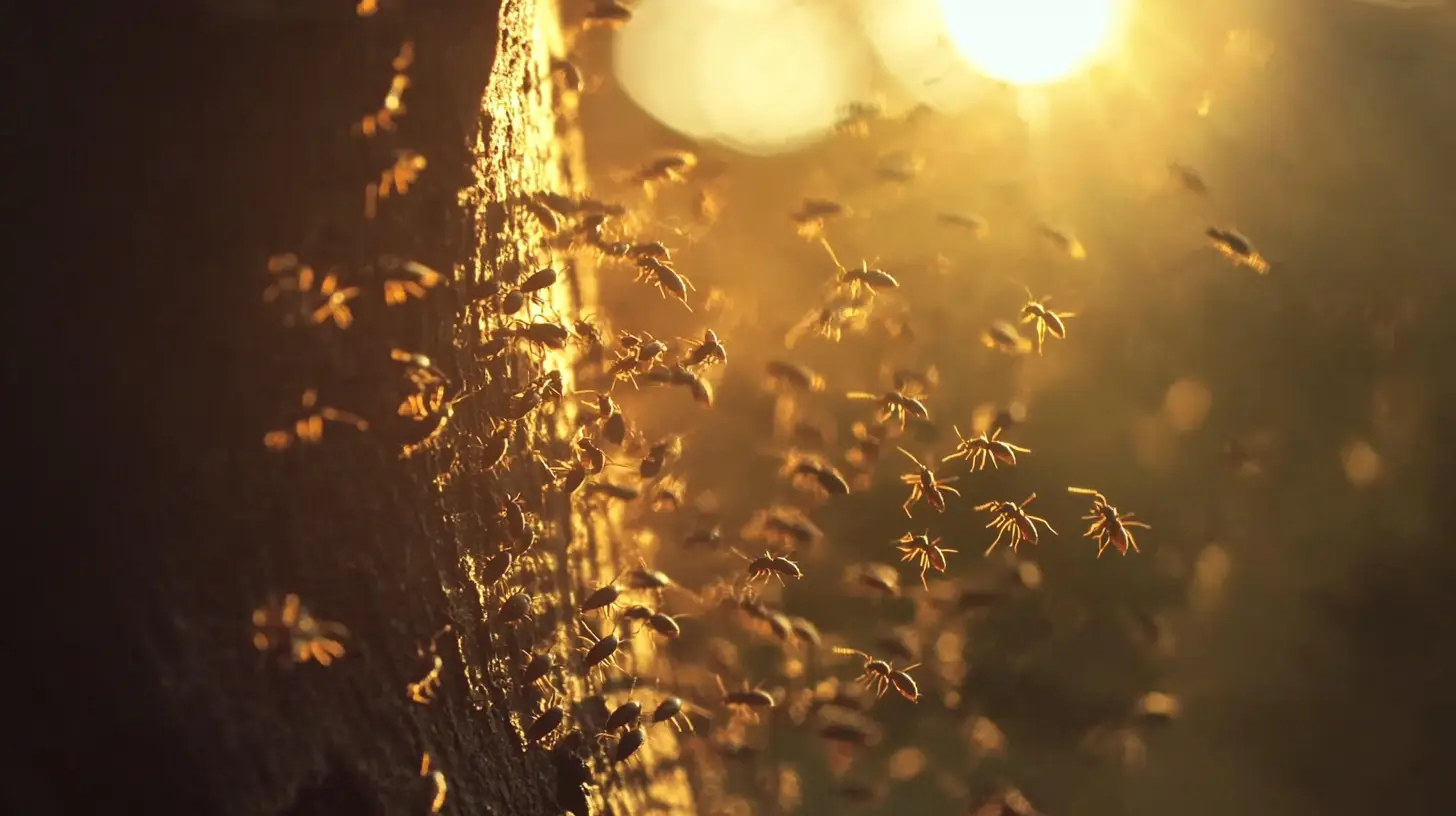
Swarmers are the winged termites, and they are the ones people see most often. They leave the colony to mate and start new ones. UF/IFAS gives these descriptions for Florida species:
- Eastern subterranean termite swarmers are dark brown, “almost black to the naked eye,” and approximately 0.4 inch long including the wings, per the UF/IFAS profile of native subterranean termites.
- A second native species, Reticulitermes hageni, has yellowish brown swarmers approximately 0.3 inch long, per the same UF/IFAS profile.
- West Indian drywood termite swarmers have a darker body and two pairs of hairless, “vividly iridescent” wings with three to four darkened veins along the front edge, per the UF/IFAS profile of the West Indian drywood termite.
When they fly is a clue too. UF/IFAS reports eastern subterranean flights in Florida from early January to April, on warm, sunny, windless early afternoons, usually after rain. Reticulitermes hageni flies from early December to early February, in the evening. West Indian drywood termites fly mainly from April to June, and UF/IFAS adds that flights are possible any time of the year. A date narrows the list. It does not confirm a species.
Termite swarmer or flying ant?
Three body parts separate a termite swarmer from a winged ant. UF/IFAS lists the ant side in its Florida carpenter ant profile, and the termite side is the opposite on each point.
| What to check | Termite swarmer | Winged ant |
|---|---|---|
| Waist | Broad, no pinch | Constricted |
| Antennae | Beaded | Elbowed |
| Wings | Four wings of equal size | Fore wings larger than hind wings |
| Size example | Eastern subterranean: about 0.4 inch with wings | Florida carpenter ant female: up to 20 mm (3/4 inch) |
| Flight window in Florida | Eastern subterranean: early January to April, early afternoon | Florida carpenter ant: May through November, evening or night |
Source: UF/IFAS Featured Creatures profiles EENY-212 (native subterranean termites) and EENY-272 (Florida carpenter ant). Flight windows are clues and do not confirm a species.
Pro tip: put the insect on a white sheet of paper and use your phone camera at full zoom. The waist and antennae show up on screen when they are too small to see by eye.
What soldiers and workers look like
Soldiers and workers stay inside the wood or the soil, so you see them only when something breaks open. That happens when you pull off a piece of trim, open a mud tube or move a stored box.
- Native subterranean soldiers (the Reticulitermes group, which includes the eastern subterranean termite) have a rectangular head, and their mandibles curve at the tip in an S shape, according to UF/IFAS. Soldiers of Formosan and Asian subterranean termites have an oval head instead, so a head shape that does not match is not a reason to rule out termites.
- West Indian drywood soldiers have dark, rough-textured (rugose) heads, per UF/IFAS.
- Drywood workers are cream-white. UF/IFAS calls them pseudergates, and they do the work of the colony.
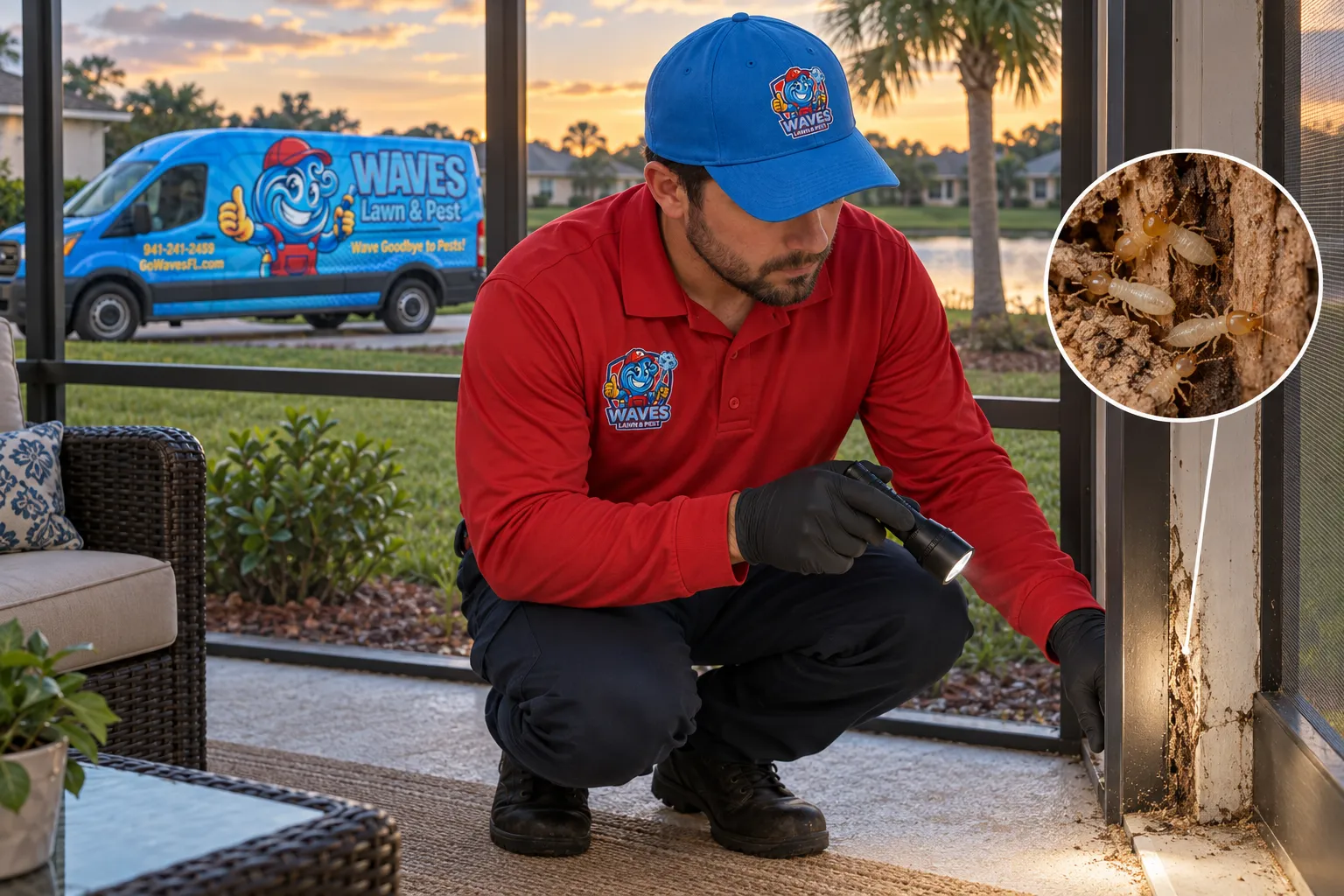
People call these “white ants.” They are soft, pale and avoid light. If pale insects spill out of wood you just opened, stop and take a photo before they retreat.
Signs to look for when you cannot find the insect
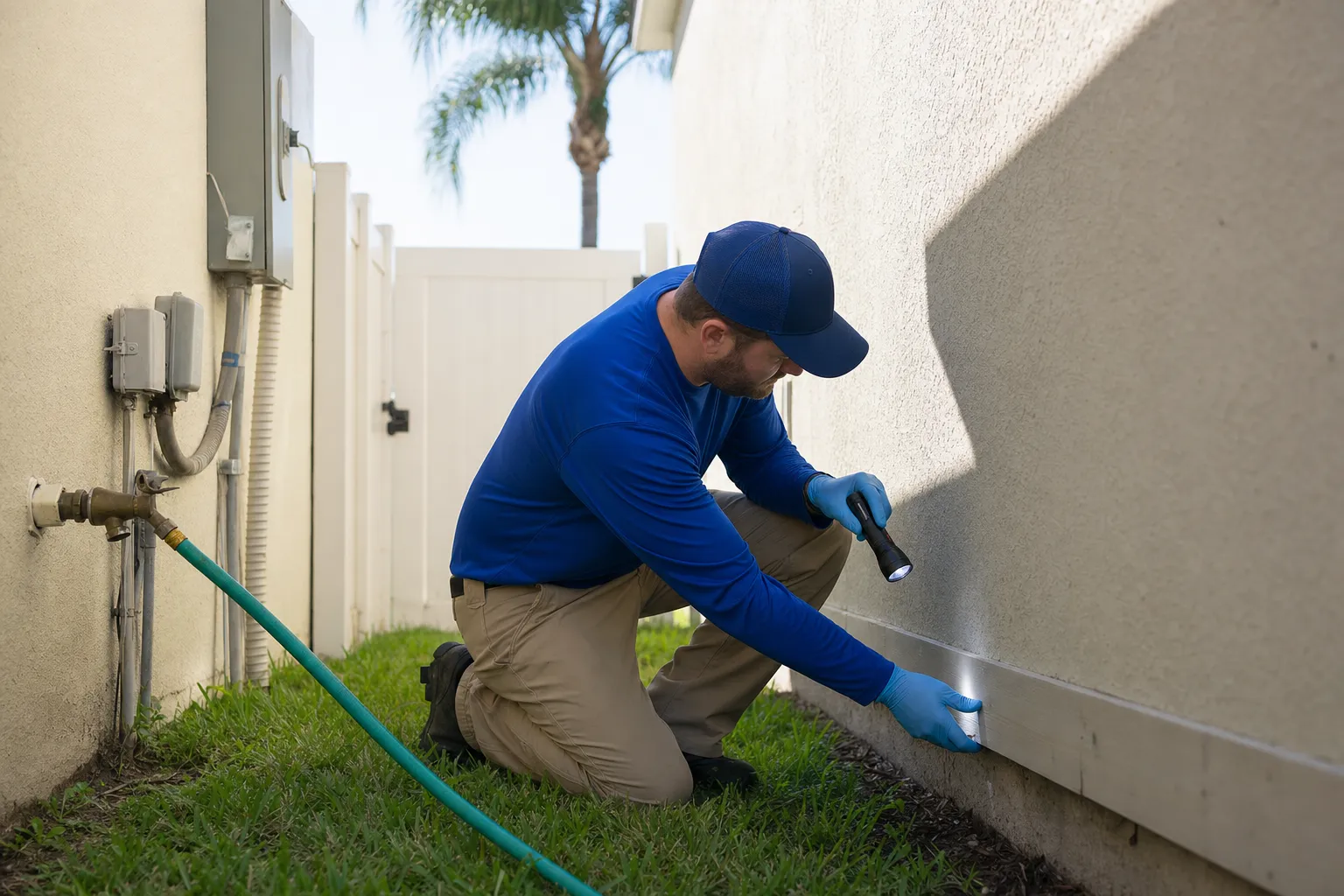
Most termite problems are found by what the colony leaves behind. Check for these with a flashlight:
- Pellets. West Indian drywood termites push out fecal pellets that are hexagonal in cross section and cream, red or black, per UF/IFAS. The holes they push them through are 1 to 2 mm in diameter. Look for small piles on sills, baseboards and the floor under wood trim.
- Mud tubes. Subterranean termites build shelter tubes. UF/IFAS calls them “the equivalent of highways” that connect the colony in the ground with food above it. Inspect the slab edge, garage walls and plumbing entries.
- Blistered wood. UF/IFAS says the surface of badly damaged wood “may appear blistered or peeling” because termites hollow it out and leave a paper-thin surface.
- Shed wings. A pile of same-size wings on a sill or in a spider web is a clue that a swarm happened nearby. Save a few for the inspector.
Why Southwest Florida sees more than one kind
Two groups of termites cause most home infestations here, and they need different treatment. UF/IFAS says the eastern subterranean termite and Reticulitermes virginicus are both found statewide. A single subterranean colony may hold 100,000 to 1,000,000 termites. They live in the soil and can forage up to 150 feet from the colony, per UF/IFAS.
The West Indian drywood termite lives entirely inside wood with no soil contact. UF/IFAS says it has spread through coastal regions of Florida, with the largest populations in older buildings in the southern half of the state. That is why the species matters before anyone quotes a job.
A third group, dampwood termites, lives in wet or decaying wood. UF/IFAS lists the Florida dampwood termite from central through south Florida and reports that it rarely infests structures. If you find termites only in rotting, wet wood, our guide to dampwood termites explains why fixing the moisture comes first. Our post on termite treatment in Bradenton covers how the two are handled, and our guide to Sentricon bait stations in Southwest Florida explains one option for subterranean termites.
What draws subterranean termites to a house
Moisture and wood that touches soil are the main draws. These are the conditions a termite inspection flags around a slab home:
- Mulch or soil banked against stucco above the slab line.
- Wood touching soil, such as fence posts, deck posts or stored lumber.
- Steady moisture at the foundation from a leaking AC condensate line or irrigation.
- Form boards or wood and paper debris left under or against the slab.
Fixing these lowers the odds of an attack. It does not replace an inspection or a treatment.
How to choose your next step
Match what you found to the action that fits.
- If you found winged insects with a broad waist and equal wings, call a licensed professional for species confirmation and save a sample.
- If you found six-sided pellets under wood trim or furniture, schedule a professional look at that wood and the rooms around it. Pellets point to drywood termites.
- If you found mud tubes on the slab or a wall, call a professional and leave the tubes in place so the activity can be traced.
- If the insects have a pinched waist and elbowed antennae, use an ant plan. That is a winged ant.
- When you found only shed wings outdoors and nothing inside, check the sills, slab edge and nearby wood trim now, and look again over the next few weeks. Different termite species fly at different times of day and year, so do not wait for one kind of weather.
What not to do
A few common reactions make identification harder.
- Do not spray the swarmers with a household insecticide and throw them away. The spray does nothing to the colony, and the sample is what a professional needs.
- Do not scrape off mud tubes or vacuum up every pellet before anyone has seen them.
- Avoid judging by color alone. Swarmers range from yellowish brown to almost black across species.
- Do not assume a swarm outside means the house is infested, or that no swarm means it is clear.
When to call a professional
Call when you find swarmers indoors, pellets, mud tubes or damaged wood. A photo helps, and a physical sample is better. Species ID decides the treatment, and that takes a trained look at the insect and the structure.
Waves Pest Control inspects homes in Sarasota, Bradenton, Venice and nearby Southwest Florida communities, identifies the species and gives a written quote. No inspection can promise that a home is free of termites, since it covers the areas that can be seen and reached. Request a Termite Estimate or read what our termite inspection covers.