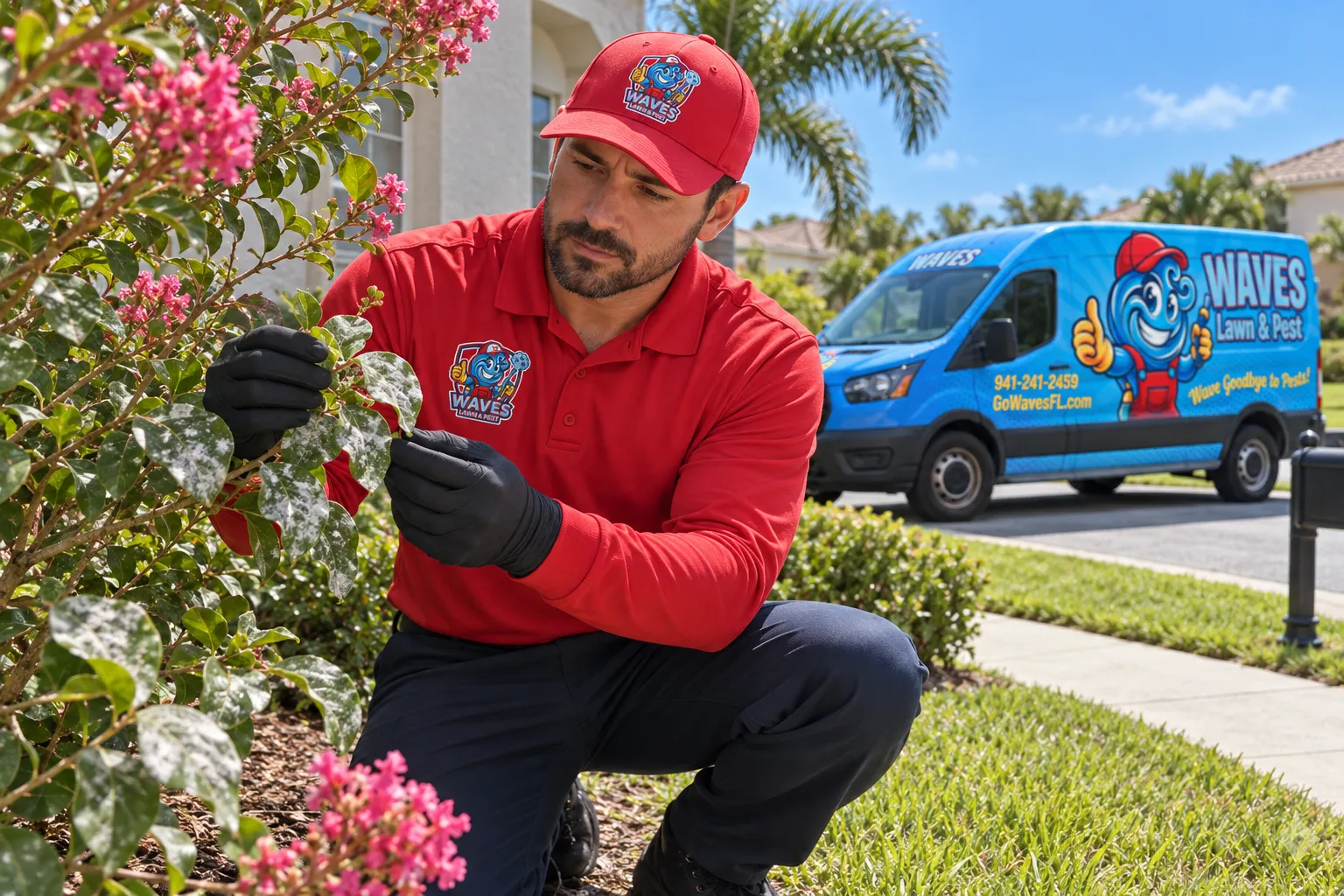
A dusty white coating on the newest crape myrtle leaves and flower buds points to powdery mildew. UF/IFAS says crapemyrtles are especially susceptible to it, and its guidance leans on three things you control before any spray bottle comes out: the variety you plant, how much sun it gets, and how air moves through the canopy.
In Parrish, check the setting around the tree. Much of the town is newer master-planned construction on former ranch land, and St. Augustine dominates those neighborhood lawns. A crape myrtle planted in or beside an irrigated lawn can catch the sprinkler spray, and wet leaves help this disease along. For the bigger picture on the plants around your house, see our page on tree and shrub care in Parrish. If you want someone to look at the tree with you, get a tree and shrub care estimate.
What powdery mildew looks like
Start with the youngest growth. UF/IFAS describes the disease on crapemyrtle in its fact sheet EP560 on crapemyrtle pests (revised February 2025) as a white, powdery covering that grows on the surface of leaves, shoots and buds, with leaf curling and growth distortion.
The UF/IFAS powdery mildew guide fills in the rest:
- Spots first. It starts as spots or patches of white powder, usually on the leaves, that quickly enlarge into a dusty white or gray coating.
- Twisted growth. On crapemyrtle it causes leaves, stems and flowers to become distorted and stunted.
- Lost leaves and blooms. In severe cases, leaves may drop early and flower buds may fail to open properly.
The guide names the cause on crapemyrtle as the fungus Erysiphe lagerstroemiae. The white film is the fungus itself, growing on your tree. Wet leaves help it along, which the next section covers.
What it is not
Two other crape myrtle problems leave a coating, and they need different fixes. Identify which one you have before you treat anything.
- A black coating is sooty mold. EP560 says crapemyrtle aphids, pale yellow insects about 1/8 inch long that sit mostly on the leaf undersides, secrete honeydew that sooty mold grows on. The same fact sheet says sooty mold is often the first thing people notice, and by then the aphid infestation is already well established. Our guide to signs your shrubs have a pest problem covers sooty mold on other landscape plants.
- A white to gray crust on the bark is likely crapemyrtle bark scale. EP560 says the individual scale insects are white to gray and ooze pink when crushed, building up in branch crotches and along branches. It says this scale usually is not on new growth, leaves or slender stems unless the infestation is heavy, and it calls the pest difficult to control. For scale insects on other plants, see our guide to hibiscus mealybug and croton scale.
Why it shows up in spring and fall
Powdery mildew on crapemyrtle runs on the shoulder seasons. EP560 says it is most active in the cool, dry periods of spring and fall and is most severe in shady locations. The UF/IFAS powdery mildew guide adds that shady, humid spots and cool nights encourage it, as does frequent wetting of the foliage by irrigation or rainfall.
So if you’re seeing white leaves in Parrish this November, the timing fits. Summer afternoon storms soak the canopy too, but the spring and fall pattern is the one UF/IFAS describes for this disease.
Pro tip: Walk past your crape myrtle while the sprinklers run. If the spray hits the leaves, adjust or turn that head so it waters the ground under the tree. UF/IFAS lists frequent wetting of the foliage by irrigation among the things that encourage powdery mildew, and the UF/IFAS crapemyrtle page notes an established tree is extremely drought tolerant.
The same advice holds for a crape myrtle in Palmetto or Lakewood Ranch. The UF/IFAS fact sheet ST342 on crapemyrtle lists sand among the soils the tree tolerates, though it says crape myrtle grows best in full sun with rich, moist soil.
How to pick a variety that resists it
Plant a resistant cultivar. The UF/IFAS powdery mildew guide calls that the best way to avoid the problem, and the UF/IFAS crapemyrtle page says to choose a disease-resistant cultivar known to perform well in Florida.
Current UF/IFAS material names these cultivars for mildew resistance. Sizes and colors come from the cultivar table in the UF/IFAS pruning guide ENH1138 (revised December 2024) unless noted:
- ‘Tonto’: 5 to 10 feet, dark red flowers, resistant to powdery mildew and other diseases.
- ‘Acoma’: 10 to 15 feet, white flowers, weeping branches. ST342 and the UF/IFAS crapemyrtle page both call it resistant to powdery mildew.
- ‘Catawba’: 12 to 15 feet, purple flowers, good mildew resistance.
- ‘Sioux’: 15 to 20 feet, dark pink flowers, high resistance to mildew.
- ‘Tuscarora’: coral pink flowers, excellent resistance to leaf spot and mildew.
- ‘Muskogee’ and ‘Natchez’: large trees at 20 to 25 feet (lavender) and 25 to 30 feet (white). ST342 says these two and ‘Tuscarora’ are hybrids with greater resistance to mildew.
- ‘Biloxi’: about 25 feet with pale pink flowers, described in ST342 as hardy and mildew resistant.
Two caveats from the same sources. ST342 says the USDA releases may prove more resistant to powdery mildew in the deep south, but further testing needs to be done to confirm it. And EP560 says mildew-resistant varieties appear to be highly susceptible to the crapemyrtle aphid, so a resistant tree can still end up sticky and black.
Size matters as much as resistance. ENH1138 says a crapemyrtle that needs routine pruning to fit its space should be considered for replacement with a smaller-maturing cultivar.
Sun, spacing and pruning
Full sun comes first. The UF/IFAS crapemyrtle page says the tree performs best in full sun, and ST342 says crape myrtle is susceptible to powdery mildew damage especially when planted in some shade or when the leaves are kept moist.
Give it room. The powdery mildew guide says the disease thrives in crowded plantings and recommends sunny spots with free air movement so wet foliage dries quickly. ENH1138 says a crapemyrtle planted in full sun, away from walkways and roads, with room to grow may need little or no pruning, and forms a round canopy that often reaches the ground.
Interior thinning for air flow is an older recommendation. ENH1138 says thinning the interior twigs and branches was the recommended technique before disease-resistant cultivars came along, because better air movement kept foliage dry and reduced powdery mildew. The same guide calls the practice unnecessary for modern, disease-resistant cultivars.
Go easy on feeding while you’re at it. The UF/IFAS crapemyrtle page says established trees have low fertility requirements. In Parrish, Manatee County’s summer fertilizer rule also bars nitrogen and phosphorus from June 1 through September 30.
How to prune without topping
Wait for dormancy. ENH1138 says structural pruning should happen when the tree is leafless and dormant, typically December through February, and severe pruning should wait until late in that period, since cutting too early might push new growth that low temperatures can damage. When you do prune, keep the cuts small and specific:
- Suckers. The UF/IFAS pruning page says to remove the small sprouts that develop along main stems or roots.
- Crossed or rubbing branches. The same page says to remove the weaker of the two limbs.
- Dead, damaged or diseased branches. ENH1138 says to cut these at the branch collar.
Why topping does more harm
Topping is what UF/IFAS calls “crape murder”: the drastic removal of large, several-year-old wood that shortens every stem. ENH1138 does not recommend it, and lists what it costs the tree:
- Flowering typically comes up to a month later than on an unpruned tree, and on some cultivars the bloom season gets shorter. ENH1138 says the same of pollarding.
- Long, unbranched sprouts grow from the cuts, bend under their own weight, and some break in rain or wind.
- Hard pruning causes excessive sprouting from the roots and the base of the trunk.
- The large stubs expose wood to insects and wood-rotting organisms.
The UF/IFAS pruning page adds that topping can shorten the life of the tree. If size is the issue, ENH1138 says pollarding reduces size with fewer dead stubs and less decay than topping, though it commits you to pruning every year. If an HOA or a landscape crew handles the trees in your Parrish neighborhood, UF/IFAS suggests asking about their pruning techniques.
How to fix a topped tree
The UF/IFAS pruning page gives two options. Keep the strongest two or three sprouts on each stub and remove the rest, and repeat for a couple of seasons. Or cut the tree back to within one to two inches of the ground while it is dormant, then, after two to three weeks of growth, keep three to five of the most vigorous new shoots on each trunk. The page says the second route gives you a natural-looking crapemyrtle within three to five years.
When to spray a fungicide
Save the sprayer for a specimen tree you want to keep looking good. EP560 says to use approved fungicides when conditions favor disease development, which for this disease means the cool, dry stretches of spring and fall.
If you go that route:
- Confirm it is powdery mildew first, using the checks above.
- Pick a fungicide labeled specifically for powdery mildew, as the UF/IFAS powdery mildew guide directs.
- Read and follow the product label, keep the product off food-preparation surfaces, and keep it out of sight and reach of children and pets.
A spray leaves the setup in place. Shade, crowding and wet leaves still favor the disease, so fix those too.
When to call a professional
Have a local pro take a look when the whole canopy stays white through the season, when branches die back, or when you find black sooty mold or a pink-oozing crust on the bark along with the mildew. A tall tree is also hard to cover from the ground. EP560 points homeowners to their local UF/IFAS Extension office for help identifying crapemyrtle pests, and the UF/IFAS Extension office in Manatee County serves Parrish.
Before anyone visits, note the cultivar if you know it, where the coating shows up, and when you first saw it. Photos of the leaves, buds and bark help. If you’d like Waves Pest Control to take a look in person, request a tree and shrub care quote and include your notes. Our Parrish lawn care page covers the St. Augustine around the tree.