Jump to a section (10)
- 011. Sticky film or black sooty coating on the leaves
- 022. White cottony masses packed into stem joints
- 033. Fixed bumps along stems that rub off
- 044. Stippled, faded leaves with fine webbing
- 055. Leaf drop on one plant while its neighbors look fine
- 066. Chewed notches and holes with a pattern
- 07Rule out water: what drought and overwatering look like
- 08Before you spray anything
- 09When to call a professional
- 10How we chose these six
Last updated: November 2026.
The six signs of a shrub pest problem are a sticky film or black sooty coating on the leaves, white cottony masses at the stem joints, fixed bumps on stems that rub off, stippled and faded leaves with fine webbing, sudden leaf drop on one kind of plant while its neighbors look fine, and chewed notches or holes that follow a pattern. Each one points to a feeding insect or mite you can go and find.
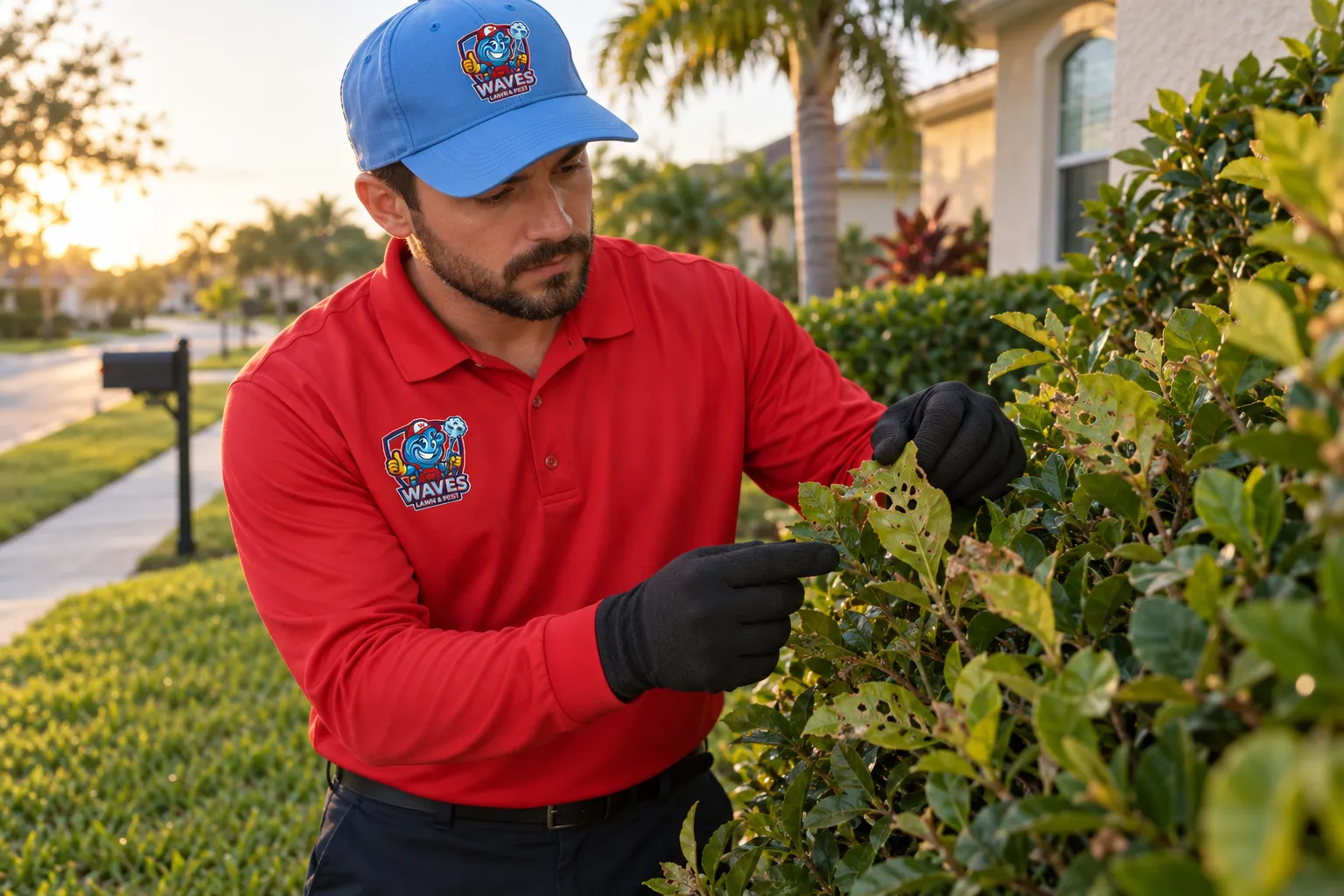
A declining hedge gets blamed on the sprinklers first, and sometimes that is the answer. The part that looks sick is not always where the trouble started. For the plants themselves, see our page on tree and shrub care in Sarasota. If you would rather have someone identify the insect with you, get a tree and shrub care estimate before anything gets sprayed.
1. Sticky film or black sooty coating on the leaves
A sticky shine or a black, dusty coating points to a sap-feeding insect excreting honeydew on the plant or somewhere above it. UF/IFAS Extension explains in its article on sooty mold that the black fungus “does not attack the plant itself.” It grows on honeydew, the excess sugary sap that aphids and whiteflies excrete, and it is mostly cosmetic, though it can cut the sunlight a leaf gets. Mealybugs and soft scales leave honeydew too.
Two checks from the sooty mold article narrow it down:
- Follow the ants. Ants feed on honeydew, so ants running up and down the stems mean it is time to check the leaf undersides.
- Look up. Plants under large trees often get sooty mold from honeydew that insects in the tree drop onto them.
The fix is to manage the insect making the honeydew.
2. White cottony masses packed into stem joints
White fluff tucked into the crotches of a shrub points to mealybugs. UF/IFAS Extension in Charlotte County says an infestation appears as cottony white patches, and a close look shows several insects clustered together. The article says mealybugs stay mostly in a plant’s “nooks and crannies,” roots included, so check where leaves and twigs meet the stem.
The article says mealybugs inject chemicals that cause distortion, stunting and yellowing, and that new plants can carry them in, so inspect new plants before planting. If hibiscus or croton is your problem plant, our guide to hibiscus mealybug and croton scale goes deeper on those two.
3. Fixed bumps along stems that rub off
Bumps that never move, lined up on stems or under leaves, can be scale insects. UF/IFAS Gardening Solutions says scale insects hide under a “scale” covering that is sometimes hard and sometimes fuzzy, sit in one spot and suck plant juices, weakening or even killing the plant. For tea scale, a camellia and holly pest, it lists leaf yellowing, dropping leaves and branch dieback among the signs.
Scale can pass for part of the plant. The UF/IFAS EDIS fact sheet ENY-323, Scale Insects and Mealybugs on Ornamental Plants, says scales may look like fungal growths or plant parts and can hide in bark crevices or leaf axils. Use a hand lens, then run a fingernail across a bump: the fact sheet notes a scale’s waxy cover can be rubbed off, and that squeezing tells live from dead, since live scales exude body fluid and dead ones are dry.
A missing sticky film does not rule scale out: ENY-323 says soft scales excrete a lot of honeydew, while armored scales do not. On branches, Gardening Solutions describes lobate lac scale, a potentially damaging pest in southern Florida, as reddish-brown, x-shaped insects that blend in with bark.
4. Stippled, faded leaves with fine webbing
Leaves covered in tiny pale specks, with delicate webbing underneath, point to spider mites. UF/IFAS Gardening Solutions says in its guide to aphids, mites and thrips that mites are almost microscopic, so gardeners generally recognize them by damage or webbing. Look for stippling, patches of small light-colored specks on the tops of leaves, which later yellow and fall. Light webbing under and around the foliage marks the spider mite family.
To confirm, tap a few leaves over a piece of white paper and look for mites with a magnifying lens. The same page notes that mites are generally found on stressed, dry plants, which is where watering and pests overlap.
5. Leaf drop on one plant while its neighbors look fine
When one kind of shrub sheds its leaves and the different plants beside it stay full, think about a pest that feeds on that plant. Ficus whitefly is a documented example. UF/IFAS Extension in Miami-Dade County describes ficus whitefly (Singhiella simplex) on weeping fig hedges that were losing their leaves, and says whiteflies feed on the underside of leaves and can cause wilting, yellowing, stunting, leaf drop or even death.
To confirm whiteflies, brush the plant. UF/IFAS Extension in Charlotte County says in its whitefly article that an infested plant can send up a white cloud of adults, while the immature stages sit still on the leaf underside, smaller than the head of a pin.
Pro tip: carry a sheet of white paper and a hand lens around the yard. Tap leaves over the paper for mites, shake a branch for whiteflies, and turn over a dozen leaves on the worst plant before you decide anything.
6. Chewed notches and holes with a pattern
Missing leaf tissue points to a chewing pest, and the pattern helps tell you which kind. UF/IFAS Gardening Solutions says in Different Pests Cause Different Damage that chewing damage shows up as ragged edges, holes or other missing tissue, from insects such as caterpillars and eastern lubber grasshoppers. Leafminers leave tunnels inside the leaf instead. Aphids and whiteflies cannot chew, the sooty mold article notes.
Notches cut in from the leaf edge are their own clue. UF/IFAS Extension in Charlotte County describes the Sri Lankan weevil, a small whitish-gray beetle, notching leaf margins as it chews toward the veins until a leaf looks like a doily. Mature healthy plants tolerate the damage, while young plants can be badly hurt. The weevils drop and play dead when disturbed, so shake a branch over an open umbrella to catch them.
If you find holes but no feeder and no pattern, keep that plant on a watch list and read the next section before you treat for chewers.
Rule out water: what drought and overwatering look like
Drought and overwatering both yellow leaves and drop them, so the soil decides it. A UF/IFAS Extension article on signs of summer stress lists these:
- Too little water: wilted foliage, dry soil several inches below the surface, browning leaves and leaf drop. Drooping in the afternoon heat can be normal. Persistent morning wilting may point to a more serious problem.
- Too much water: yellowing leaves, root rot, more pest and disease problems, and soil that stays soggy.
To check, UF/IFAS Extension’s drought guide for trees and shrubs says to dig down several inches with care so you do not damage roots. Soaking plants too often drowns the roots by cutting off oxygen, per an Extension article on managing water.
Southwest Florida pushes both ways. UF/IFAS Gardening Solutions notes in Plants and Drought that sandy soils hold less water than clay and that Florida’s dry season generally runs from fall to spring. Summer brings afternoon storms on top of a sprinkler zone that may be set for your St. Augustine lawn. Our guide to mulch around Southwest Florida shrubs covers depth and spacing, which matter in both seasons.
Water stress and pests can stack. Gardening Solutions says an underwatered or overfertilized plant has more concentrated nutrients in its sap, which makes it more nutritious to aphids, mites and thrips, and UF/IFAS Extension in Manatee County says in Parched Plants that drought-stressed plants give off signals that draw insect pests. Check for both.
Before you spray anything
UF/IFAS Gardening Solutions says to make sure you know what is damaging your plants before you treat. While you sort it out:
- Avoid broad-spectrum insecticides. Gardening Solutions warns that they kill beneficial insects along with the pests. Charlotte County Extension says to use no pesticides on whiteflies when you see signs of parasitic wasps at work, since spraying slows that natural control.
- Do not feed a struggling shrub to perk it up. Overfertilized plants are more nutritious to sap feeders, per Gardening Solutions. In summer, check the Manatee County fertilizer rule first: it bars fertilizer containing nitrogen or phosphorus on lawns and landscape plants from June 1 through September 30.
- Start gentle. For small, soft-bodied pests, Gardening Solutions calls a strong blast of water from the hose an effective mechanical control, and it recommends the least toxic products, such as horticultural oils and insecticidal soaps, before anything stronger. Read and follow the product label, keep it off food-preparation surfaces, and keep it out of sight and reach of children and pets. Charlotte County Extension says to skip the heat of the day, since these can burn leaves.
When to call a professional
Bring in help when you cannot identify what you found, when branches are dying back, or when the plant is too big to spray under every leaf. For heavy lobate lac scale, Gardening Solutions says the only current recommendation is branch or plant removal. Gardening Solutions also points homeowners to their county UF/IFAS Extension office for help identifying pests.
Note which plant, which signs and when you first saw them, and take a few photos. If you would like Waves Pest Control to take a look in person, request a tree and shrub care quote and include your notes. Homeowners farther south can start from our tree and shrub care in Venice page.
How we chose these six
These signs follow the way UF/IFAS sorts plant injury by how an insect feeds. The Gardening Solutions page Different Pests Cause Different Damage separates chewing damage (ragged edges, holes, missing tissue) from piercing-sucking damage (yellowing, browning and wilting from insects such as aphids, scales, spider mites and whiteflies). The UF/IFAS EDIS fact sheet ENY-323 (revised February 2004, linked above as the UF Digital Collections copy) covers the sap feeders behind sticky leaves. We kept signs you can see with a hand lens, and each section links its UF/IFAS source.