The seven spots to check on a Southwest Florida patio are plant saucers, buckets, outdoor toys, birdbaths, trash containers, stored tires and small unused pools. Once a week, empty and scrub, turn over, cover or throw out whatever holds water. That is the routine the U.S. Centers for Disease Control and Prevention (CDC) gives in its guidance on controlling mosquitoes at home. It lowers the number of mosquitoes that breed on your own property. It will not give you a mosquito-free yard.
Why a cup of water is enough
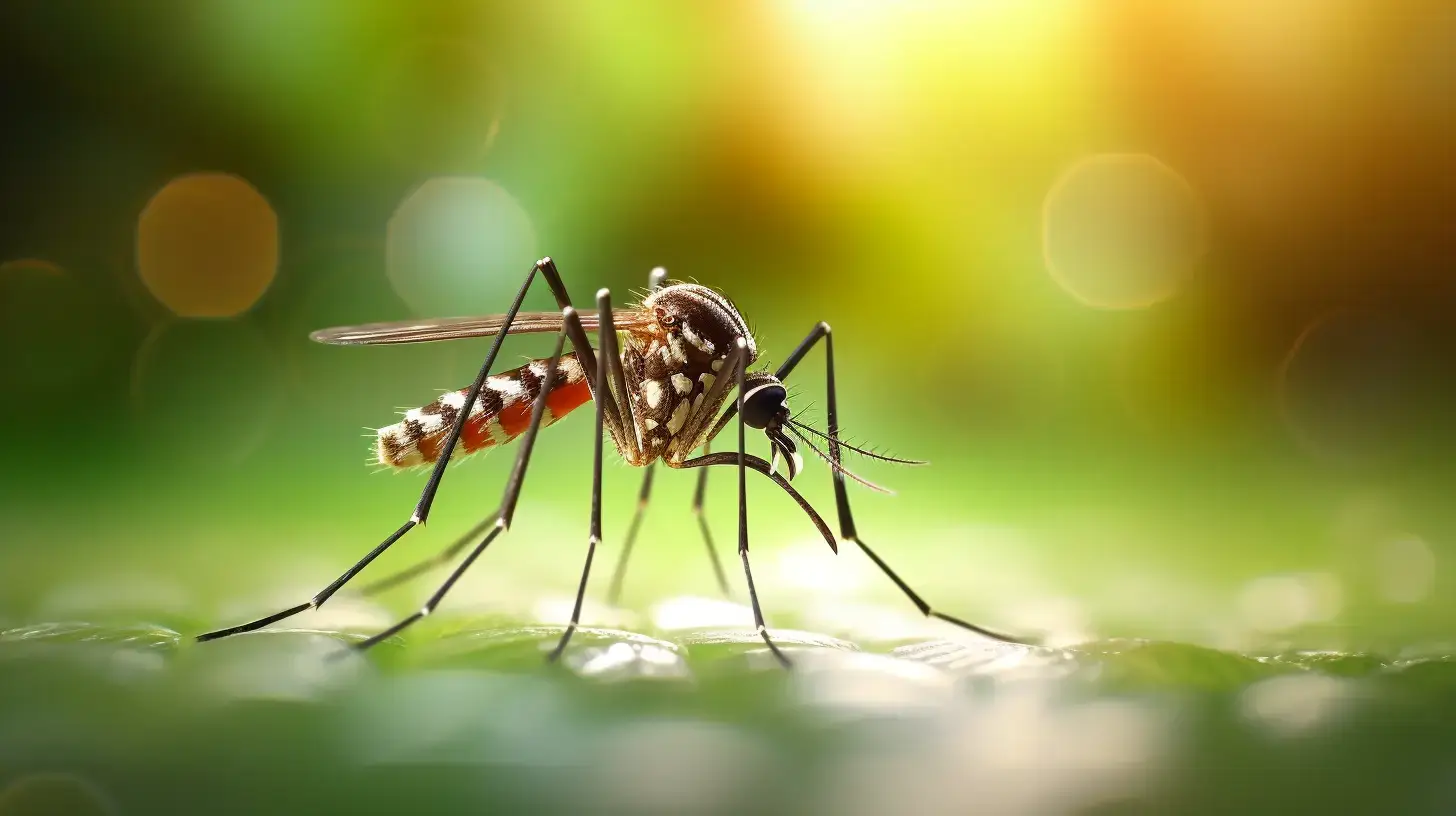
Two of Florida’s container-breeding mosquitoes show why small containers matter. According to UF/IFAS, the Asian tiger mosquito lays eggs on the sides of water-holding containers such as tires, animal watering dishes, birdbaths and flowerpots. Its larvae usually pupate after five to ten days, and the pupal stage lasts two days. UF/IFAS also notes that its eggs can withstand drying for up to a year, which is one reason the CDC says to scrub a container and not only tip it out.
The yellow fever mosquito breeds in unused flowerpots, spare tires, untreated swimming pools and “any object holding water,” per UF/IFAS. UF/IFAS says both species bite during the day, so a mosquito biting you on the lanai at noon may have bred in a container near your door.
1. Plant saucers
The CDC lists flowerpot saucers by name. Empty each saucer once a week and wipe the inside, because the CDC says to scrub, not just dump. If a plant does not need a saucer, take it off.
2. Buckets
Mop buckets, a spare pail, the one by the hose: the CDC lists buckets too. Turn them over or store them under cover. If you keep a bucket outside to collect water, the CDC says to cover it tightly so mosquitoes cannot get in to lay eggs. For a container you cannot lid, the CDC says to use wire mesh with holes smaller than an adult mosquito.
3. Outdoor toys
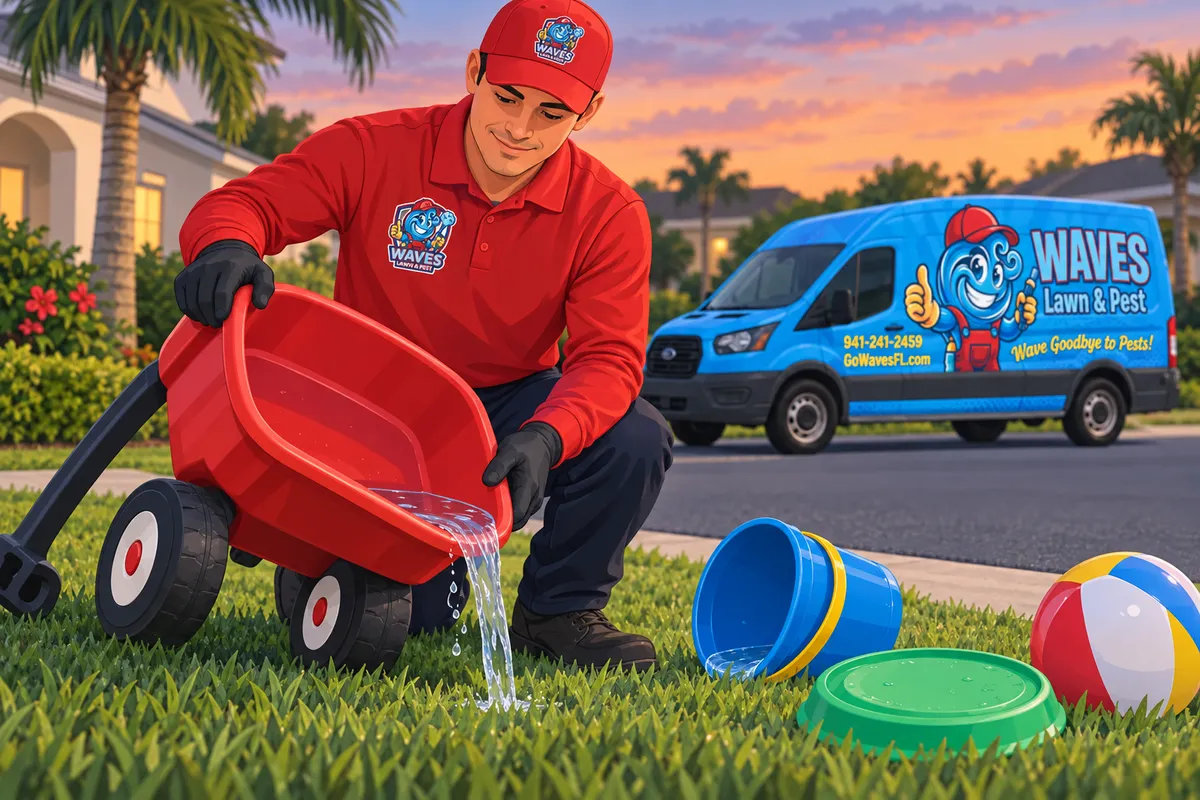
Wagons, sand pails, upturned lids, anything left in the grass can cup rainwater. The CDC and the Florida Department of Health (FDOH) both list toys. Tip them out after play and store them where rain cannot fill them.
4. Birdbaths
You will want to keep the birdbath, so empty and clean it on a schedule. The CDC lists birdbaths in its weekly check. FDOH says to empty and clean birdbaths and pets’ water bowls at least twice a week, so twice a week is the safer habit.
5. Trash containers
The CDC lists trash containers, and FDOH says to drain water from garbage cans where sprinkler or rainwater has collected. After a storm, look in the bottom of each bin and in any lid that holds a puddle.
6. Stored tires
The CDC lists tires. FDOH says to discard old tires and other items you are not using. If you keep tires, cover them or store them indoors so rain cannot collect in them.
7. Small unused pools
Kiddie pools and inflatable pools fill with every rain. FDOH says to empty plastic swimming pools when they are not in use. For a full-size pool, FDOH says to keep it in good condition and appropriately chlorinated. UF/IFAS lists untreated swimming pools among the yellow fever mosquito’s breeding sites.
Your weekly patio walk at a glance
| Spot | Weekly reset | Source |
|---|---|---|
| Plant saucers | Empty and scrub, or remove the saucer | CDC |
| Buckets | Empty, turn over or cover; screen with fine mesh if it must hold water | CDC |
| Outdoor toys | Tip out and store where rain cannot fill them | CDC, FDOH |
| Birdbaths | Empty and clean, at least twice a week | FDOH, CDC |
| Trash containers | Drain any water that collected | FDOH, CDC |
| Stored tires | Discard unused tires; cover or store the rest | FDOH, CDC |
| Small unused pools | Empty plastic pools; keep larger pools chlorinated | FDOH |
When you cannot dump it
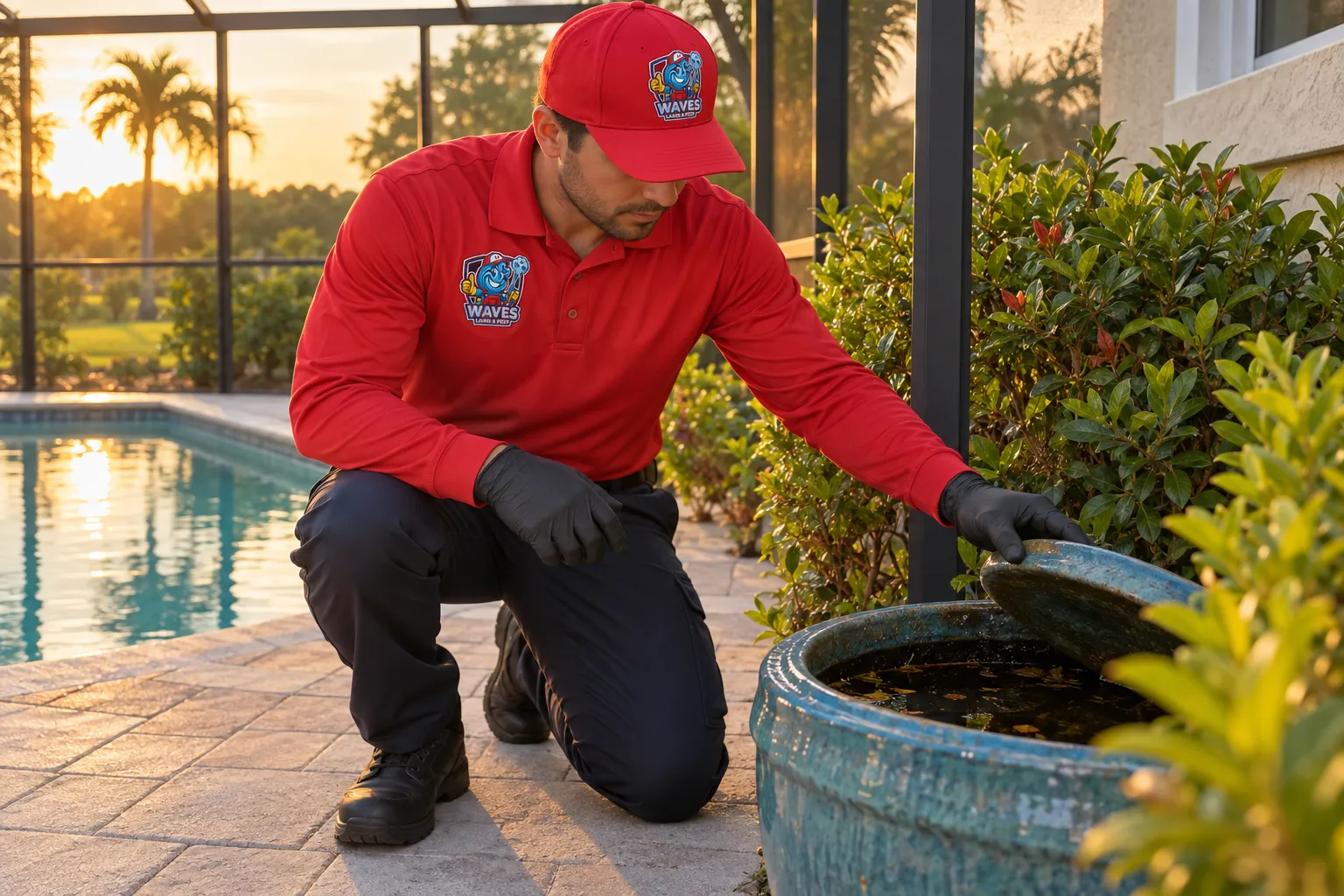
Some water has to stay: a rain barrel you use, or a pool you keep. For water storage containers, the CDC says to cover them tightly so mosquitoes cannot get in to lay eggs, or to use wire mesh with holes smaller than an adult mosquito. A pool needs ongoing care per FDOH, as covered above. You cannot clear every source yourself, such as water on a neighbor’s lot or in a nearby ditch or pond, so a clean patio lowers the numbers but does not remove the problem.
If mosquitoes stay bad after you have run the walk for a few weeks, you can ask for help. Waves Pest Control offers mosquito control in Lakewood Ranch, Sarasota and Venice, or you can contact Waves Pest Control. For a wider look at what else bites in Florida yards, read our guide to biting bugs in Florida backyards. The Manatee County rainy-season playbook covers source reduction and timing for that county.
How this list was built
The seven spots come from the containers the CDC and FDOH name in their home mosquito guidance, matched to what a Southwest Florida patio and lanai usually hold. Neither agency publishes this exact seven-item list. The grouping is ours, and each step above names its source. Bite and breeding facts come from UF/IFAS.
Frequently Asked Questions
How often should you check these spots?
Once a week at minimum, per the CDC. Check birdbaths and pet water bowls at least twice a week, per FDOH. Look again after a heavy rain, since storms refill containers you just emptied.
Will clearing standing water make your yard mosquito-free?
No. Clearing containers lowers the mosquitoes that breed on your own property. Mosquitoes can still arrive from water you do not control, such as a neighbor’s yard or a nearby ditch or pond.
Why scrub a container instead of just emptying it?
The CDC says to empty and scrub. UF/IFAS notes that Asian tiger mosquitoes lay eggs on the sides of containers, and those eggs can survive drying for up to a year. A dry container can still hold eggs that hatch when rain refills it.
What if a container has to hold water?
Cover it tightly so mosquitoes cannot get in, or use wire mesh with holes smaller than an adult mosquito, per the CDC. A rain barrel is an example.