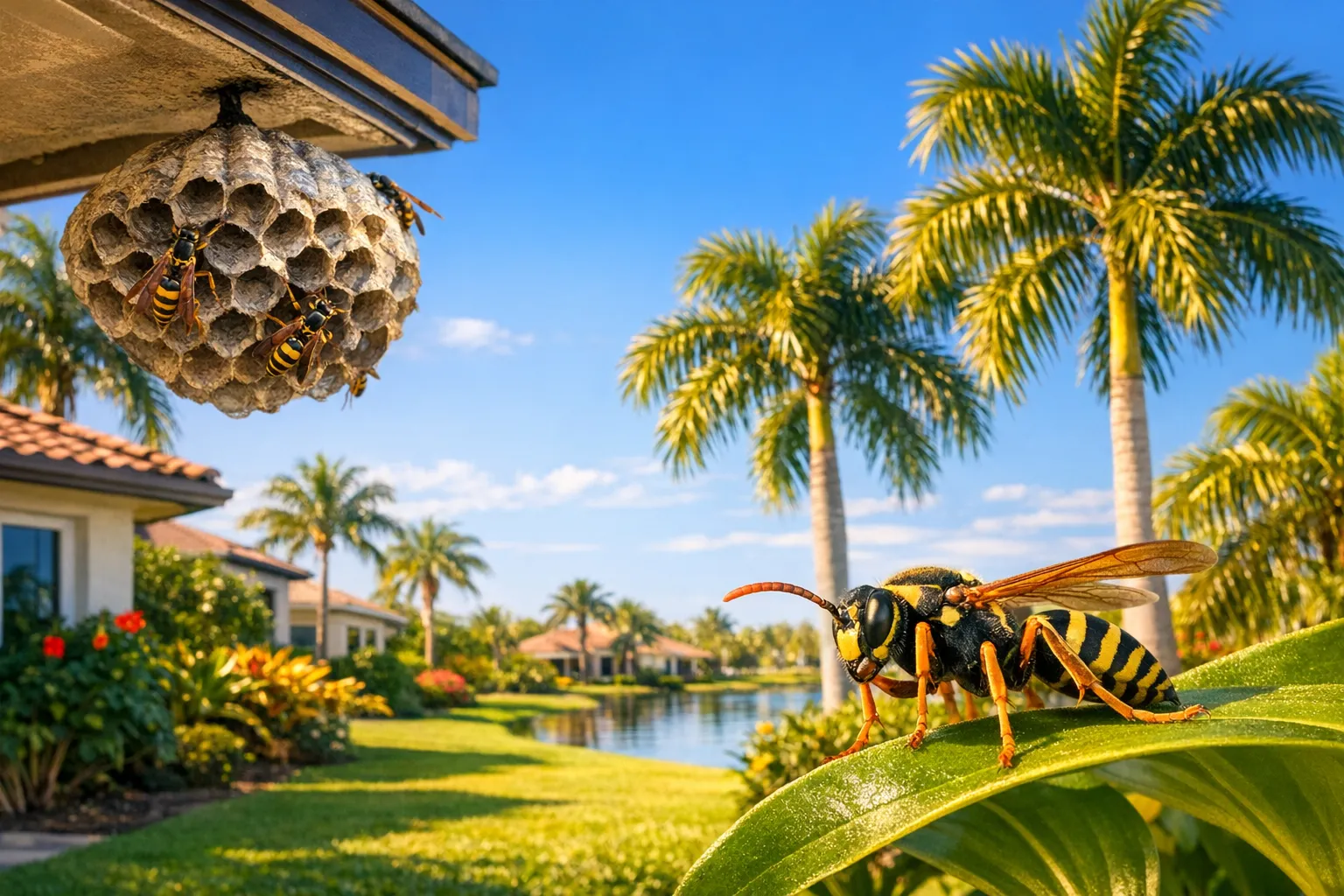
Every summer we get the same call: “There’s a wasp nest on my patio — should I knock it down myself?” The honest answer starts with the nest, not the wasp. When you can read the nest, you already know which wasp is inside, how mad it’s going to get, and whether “knock it down” is going to end well. This guide is the identification reference for the four wasps you’ll actually see around a Southwest Florida home — paper wasps, yellowjackets, mud daubers, and cicada killers — and every ID mark, measurement, and behavior in it is sourced from the University of Florida’s UF/IFAS Featured Creatures profiles.
Once you know what you’re looking at, treatment is a separate conversation. If you’re already past ID and ready to talk about removing a nest, the pest control services page has the overview, or you can request a quote and we’ll walk you through it.
Read the nest first — the wasp comes second
The three nest shapes you’ll see under a Southwest Florida eave map neatly onto three completely different wasps:
- Open umbrella comb — a single horizontal disc of hexagonal cells hanging from a thin stalk, cells facing down. That’s a paper wasp. UF/IFAS Featured Creatures describes Polistes nests as hexagonal brood cells arranged head-down toward the ground, typically attached by a pedicel to the protected underside of overhanging structures such as the eaves of houses or the hollows of trees.
- Enclosed papery envelope, hidden in the ground or a wall cavity — that’s a yellowjacket. Featured Creatures documents ground openings of about 1.5 cm (roughly a half-inch), leading to a subterranean nest whose outside envelope has the consistency of charred paper.
- Hard mud tubes stuck to a wall, ceiling, or soffit — that’s a mud dauber. The Featured Creatures profile for Sceliphron caementarium describes it as a solitary sphecid wasp that hunts spiders and builds characteristic mud nests for its offspring.
On every inspection
Wasp nest tells at a glance
- Open umbrella comb Single disc of hexagonal cells hanging by a stalk under an eave — paper wasp.
- Enclosed papery envelope Ball of layered paper in a wall void, tree cavity, or underground opening — yellowjacket.
- Hard mud tubes Cemented mud cells on soffits, sheds, or pool cages — mud dauber (solitary, spider-hunting).
- Bare, sandy burrow Golf-ball-sized hole in dry, exposed St. Augustine dead-spots — cicada killer.
Nest-first identification cues verified against UF/IFAS Featured Creatures profiles.
Pro tip: Before you touch anything, take a phone picture from a comfortable distance. Half of the “active” wasp nests we get called about turn out to be last year’s abandoned mud dauber tubes — nothing living inside.
Paper wasp: open umbrella comb, rust-red body, moderate defense
Paper wasps in Florida are in the genus Polistes. UF/IFAS Featured Creatures’ profile for the red paper wasp (Polistes carolina) puts forewing length at 15 to 20.5 mm in both sexes, with the female body nearly completely rust colored — the ferruginous, red-brown look most Southwest Florida homeowners recognize.
The nest is the giveaway: a single papery umbrella comb, often tucked under a Sarasota lanai screen frame, on the underside of a Bradenton pool cage, or in the eave of a garage. Featured Creatures notes paper wasps build their nests from wood tissue and saliva, pressing the material with their mandibles into thin, delicate layers resembling paper. Workers forage for wood fibers, nectar, water, and small invertebrates such as caterpillars, cicadas, and beetle larvae, which is why UF considers them beneficial to gardens.
Temperament: defensive, not aggressive. They will sting if you get in swatting distance of the comb — think brushing it with a broom or slamming a screen door hung two inches under it. If a paper wasp comb is out of reach and out of the way, the calm play is often to leave it alone. If it’s over your front door, it needs to come down — see our post on how to get rid of paper wasps for the treatment side.
Yellowjacket: hidden nest, spherical opening, don’t test the perimeter
Two yellowjackets show up in Florida — Vespula maculifrons (eastern) and Vespula squamosa (southern) — plus the baldfaced hornet (Dolichovespula maculata), which UF/IFAS Featured Creatures explains is actually a yellowjacket wearing a black-and-white paint job. The naming convention is straightforward: “hornet” is used for species that nest above ground, and “yellowjacket” for species that nest below.
The key ID isn’t the wasp — it’s the nest. The eastern yellowjacket typically nests underground with a nearly spherical opening about 1.5 cm (a half-inch) across, per Featured Creatures. The nest envelope has the consistency of charred paper, and mature nests documented by UF ranged from about 9.5 to 30 cm across — the largest recorded contained eight levels of comb with over 2,800 wasps. Above-ground exceptions do happen: Featured Creatures documents nests in decayed stumps, tree cavities, and between the sidings of a home.
Two things make yellowjackets the wasp you don’t want to guess at:
- Defensive radius. They’re a colony insect. Bump the entrance and hundreds of workers respond. Featured Creatures notes that even at night, when a colony is at its least active, any disturbance results in instant activity from the colony.
- Late-season nest size. Colonies grow through the summer. By late summer and early fall in Southwest Florida, a nest that was quiet in June can be very much not quiet.
If the entrance is in a wall void, a hollow soffit, or under a slab, that’s the moment to stop and get a professional involved. UF’s own Featured Creatures guidance is that when nests are large or difficult to approach — for example, within the walls of a house — the appropriate move is to hire a pest control operator.
Mud dauber: mud tubes on the eaves, and the spiders don’t stand a chance
The mud dauber gets grouped with the scary wasps by association. It shouldn’t be. The UF/IFAS Featured Creatures profile for the black and yellow mud dauber (Sceliphron caementarium) is direct: it is a solitary sphecid wasp, and stings are rare and not of medical importance to humans.
What you’ll see is the nest — cemented mud tubes plastered to soffits, sheds, garages, and pool-cage frames. Featured Creatures notes females often build their nests on urban structures such as the eaves of homes, buildings, and bridges. Inside each cell is a single egg, provisioned with up to 25 live, paralyzed spiders that the wasp packed in as larva food. It is a horror movie for orb-weavers and a genuine assist for you.
Adults are diurnal and, per Featured Creatures, most active in the late spring and summer in temperate regions. Because they are solitary, there is no colony to defend and no swarm behavior. If a mud dauber tube is somewhere you can live with, leaving it alone is a defensible choice — the wasp eats spiders, and the female never returns to a completed cell. For more on that species specifically, see our mud dauber wasps explainer.
Cicada killer cameo: two-inch wasp, giant burrow, almost no interest in you
If you have watched a wasp the size of your thumb hover over the thin, dry, sandy patches in your St. Augustine lawn during a July afternoon-storm break, that is likely Sphecius speciosus, the eastern cicada killer. UF/IFAS Featured Creatures lists them as among the largest wasps in Florida — up to 40 mm (1½ inches) in length.
The behavior looks alarming and mostly isn’t. Featured Creatures notes that the females of the common Florida species hunt Tibicen cicadas and can dig four-foot burrows in the ground with several branches and cells. Males are the ones dive-bombing you and each other; they are territorial and will butt or grapple with intruders, but they do not have a stinger. Females can sting, but Featured Creatures notes they rarely sting except when the females are handled.
Sandy Southwest Florida soil is unfortunately perfect cicada killer real estate. The wasps prefer bare, exposed sandy patches — the same weak spots that show up when a chinch-bug-stressed St. Augustine lawn thins out in the summer.
Risk snapshot: which nest, which wasp, how much respect
| Wasp / nest | Social vs solitary | Sting risk to bystanders | DIY or pro? |
|---|---|---|---|
| Paper wasp — umbrella comb under eave | Social (small colony) | Moderate if the nest is disturbed | Pro if it's near a door, walkway, or out of reach |
| Yellowjacket — hidden ground or wall nest | Social (hundreds to thousands) | High — full colony defense | Pro, especially wall/void or late-season nests |
| Mud dauber — mud tubes on structure | Solitary | Low — stings rare per UF/IFAS | Often leave alone; scrape if in an inconvenient spot |
| Cicada killer — burrow in sandy lawn | Solitary | Low — females rarely sting unless handled | Usually leave alone; address bare-soil breeding areas |
Risk profile summarized from UF/IFAS Featured Creatures. Yellowjackets are the wasp that most often warrants a professional.
Interesting facts (verified from UF/IFAS Featured Creatures)
- Paper wasps invented paper. Featured Creatures describes paper wasps chewing wood tissue and saliva and pressing the material with their mandibles into thin, delicate layers resembling paper — roughly the same process that inspired human papermaking.
- Mud daubers are spider assassins. Per Featured Creatures, a single female mud dauber lays a single egg per cell and provisions that cell with up to twenty-five live, paralyzed spiders. Multiply that by a full nest of cells.
- Cicada killer burrows are four feet long. Featured Creatures reports burrows with several branches and cells that can run four feet into sandy soil — under a Bradenton lawn, mostly ignored.
- The biggest documented eastern yellowjacket nest. UF/IFAS Featured Creatures notes the largest recorded eastern yellowjacket nest contained eight levels of comb with over 2,800 wasps. Southern yellowjacket (Vespula squamosa) colonies in the Deep South can grow considerably larger than that.
Which nests to leave alone, and which ones need a professional
Homeowner guidance, without the drama:
Often reasonable to leave alone:
- A single mud dauber tube on an outbuilding, well away from doors.
- A cicada killer burrow in a sunny, sandy patch you can rope off. Longer term, thicken the turf so the bare sand breeding site goes away.
- A small paper wasp comb starting up on a fence line or in a tree, out of foot traffic.
Do not try this yourself:
- Knocking a nest down with a broom, hose, or long stick. Featured Creatures’ documentation of instant colony activity from a disturbed yellowjacket nest is not a suggestion.
- Plugging a yellowjacket ground opening. The colony will exit through soil, siding, or interior walls if you seal the front door.
- Treating a wall-void or soffit nest. This is where stings turn into hospital visits and drywall repairs.
- Pretending a big late-summer yellowjacket nest is a paper wasp problem. The colony size and the defensive radius are completely different animals.
Call a professional when:
- The nest is in a wall, soffit, attic, or ground cavity.
- The nest is above a door, walkway, pool deck, or a child’s play area.
- Anyone in the home has a known stinging-insect allergy.
- You are not fully sure which of the four wasps above you are looking at.
How Waves Pest Control handles a wasp call
Our approach is identification-first, the same way this guide reads: we inspect the eaves, soffits, pool cage, fence lines, and the thin sandy edges of the lawn, confirm which of the four wasps is actually there, and only then talk treatment. Paper wasp combs over doorways come down. An active yellowjacket colony gets treated at the nest — not the entrance-plug gamble from the list above. Abandoned mud dauber tubes usually just get scraped off, and a cicada killer burrow is more of a turf-density conversation than a wasp treatment.
For Southwest Florida homes, a WaveGuard membership keeps a technician doing the exterior inspection that catches new nests before they become fall problems, and our broader pest library covers the rest of the insects that show up on a lanai. If you want a ballpark on cost first, the pest control calculator is a starting point.
When you’re ready, request a quote and we’ll come look. Identification is free; getting stung is not.
Sources: UF/IFAS Featured Creatures profiles for Polistes carolina (EENY640), Vespula and Dolichovespula spp. (EENY-081), Sceliphron caementarium (EENY-653), and Sphecius speciosus / Sphecius hogardii (EENY295), all available at entnemdept.ufl.edu/creatures.