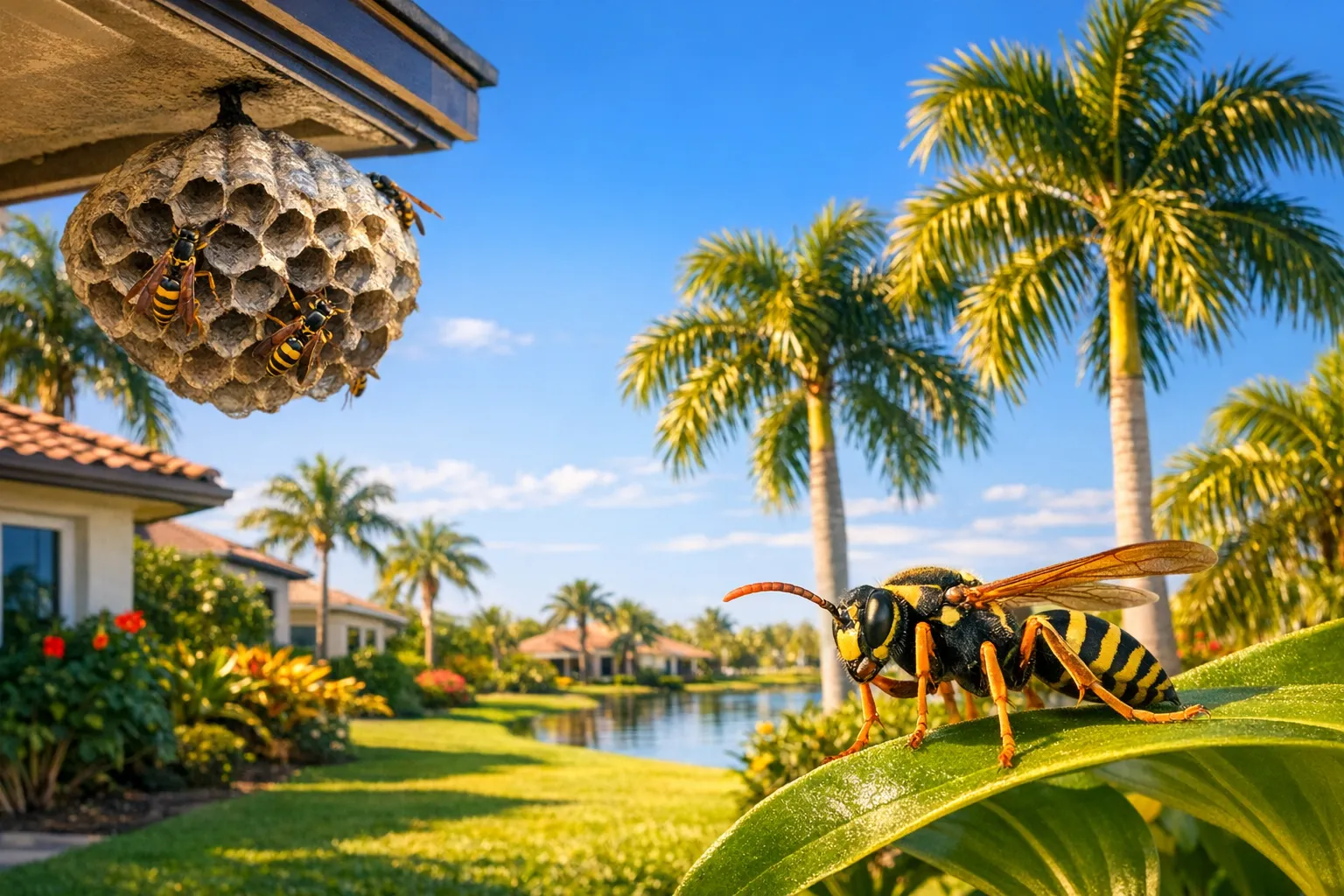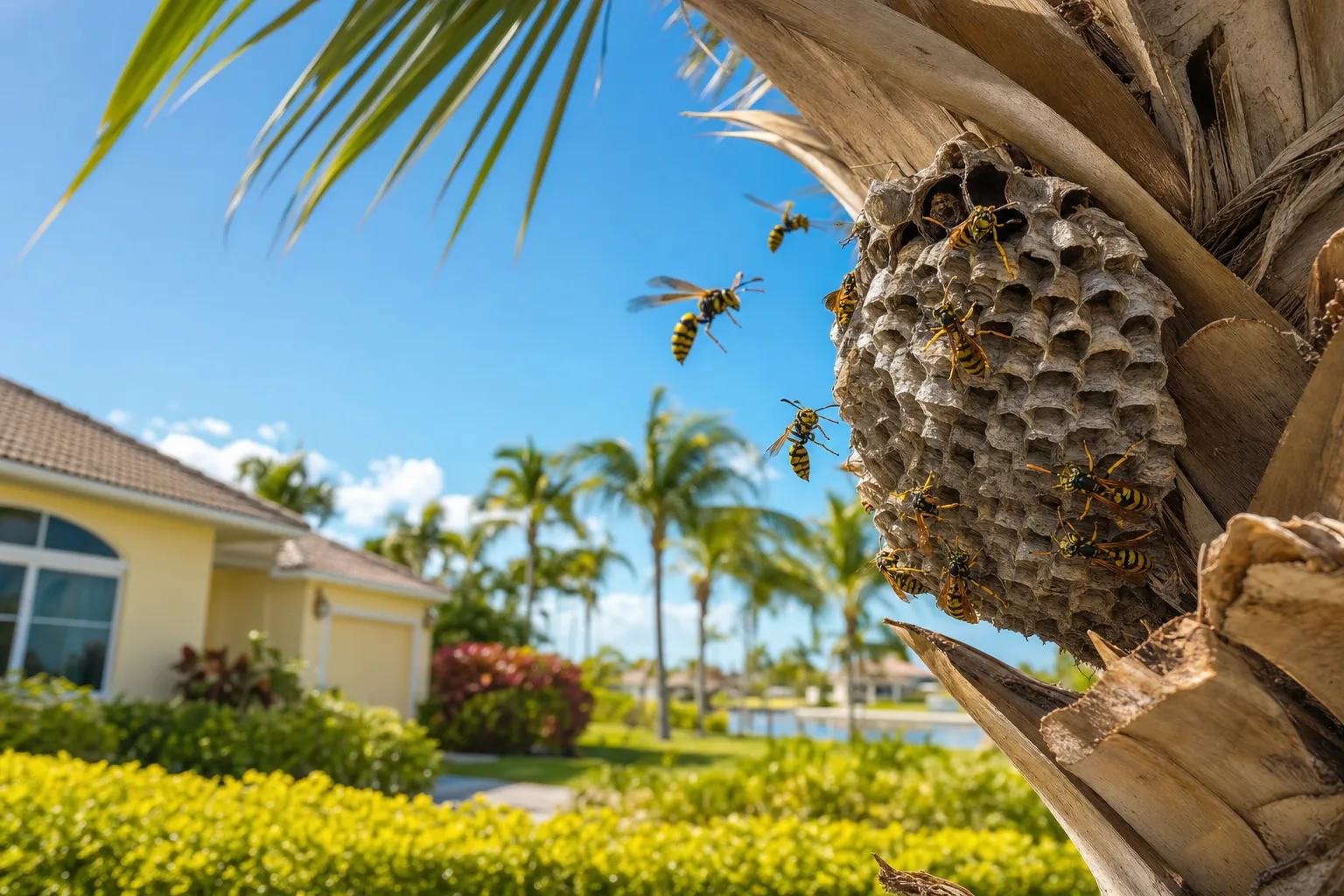
Hard mud tubes or lumps on a wall, soffit, garage ceiling or lanai frame are usually the work of mud dauber wasps. Among the stinging wasps people find at Florida homes, it is one UF/IFAS describes as docile. Still, not every nest on a wall is a mud dauber’s, and a few precautions apply.
This post covers what mud daubers are, how to read their nests, whether they sting, and what to do about a nest. For the other Florida wasps, see our Florida wasp identification guide, and for what to do about the aggressive ones, our wasp control guide.
What mud dauber wasps are
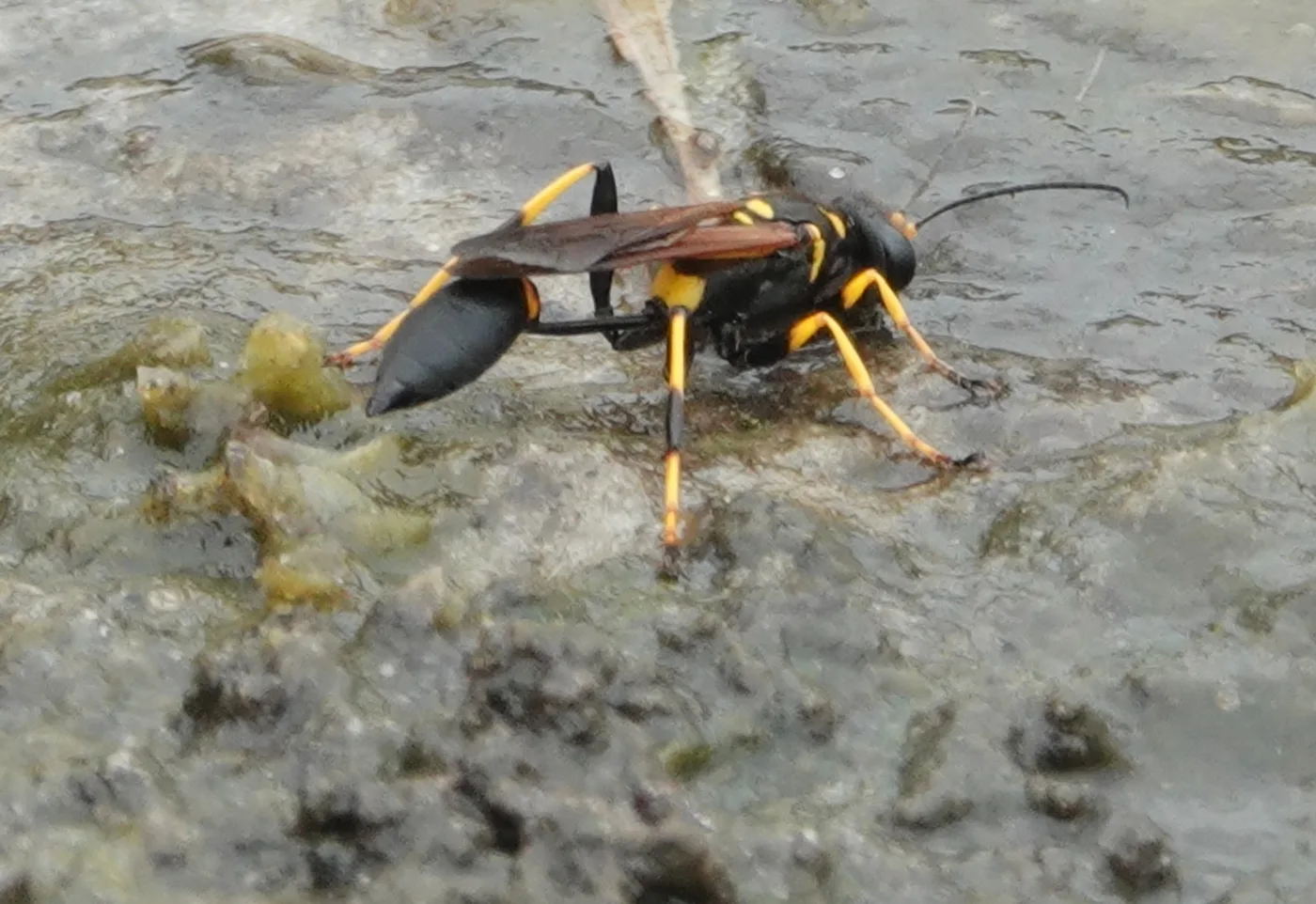
Mud daubers are solitary wasps. UF/IFAS describes the black and yellow mud dauber as a common, widely distributed wasp that hunts spiders and builds mud nests for its young (UF/IFAS).
Each female stocks her nest cells with spiders. According to UF/IFAS, she lays a single egg in each cell, which she provisions with up to twenty-five live, paralyzed spiders. The spiders are food for the larva that hatches. UF/IFAS says females prefer spiders that build orb webs, and also take crab spiders, jumping spiders and others. Adults themselves feed on nectar and the body fluids of their spider prey.
The nests you will see
Three kinds of mud dauber nest turn up on Florida homes, according to UF/IFAS:
- Black and yellow mud dauber: a clustered, rectangular mud structure. UF/IFAS says females often build on urban structures such as the eaves of homes and buildings.
- Organ pipe mud dauber: a black wasp that builds distinctive tubular mud nests.
- Blue metallic mud dauber: a metallic blue wasp that, per UF/IFAS, can be seen “renovating and reusing” the mud nests of the black and yellow mud dauber. An old nest can therefore be taken over by another wasp.
UF/IFAS also shows an older black and yellow mud dauber nest with exit holes where the adults have already left.
Our pest identifier page for mud daubers has a quick visual check.
Do mud daubers sting?
Rarely. UF/IFAS says stings from the black and yellow mud dauber are “rare and not of medical importance to humans,” and describes the wasp as docile, stinging a person only when handled roughly. The UF/IFAS guide to stinging insects agrees that mud daubers “usually are not as aggressive and will not sting unless touched or accidentally caught in clothing” (UF/IFAS).
That is a different story from paper wasps, yellowjackets and hornets, which the same guide says will sting. Telling a mud nest from a paper nest is the key step. A paper wasp nest is an open comb of cells under an eave or ledge, made of papery material. A mud dauber nest is hard and made of mud. If it looks papery, or if wasps are streaming in and out of a hole in the ground or wall, it may be something else, and the advice in our guide on how to get rid of wasps applies.
Do you need to remove a mud dauber nest?
On a wall, eave or ceiling, that is usually your call. UF/IFAS says mud dauber nests “may be considered a nuisance because they are often built on urban structures.” Machinery is the exception. The same UF/IFAS profile warns that nests built in unusual spots can cause serious problems in car engines, airplanes and other mechanical devices. The UF/IFAS fact sheets we read do not give a removal method, so these steps are a matter of judgment rather than a UF/IFAS procedure:
- Leave it if the nest is on a wall or ceiling you do not mind, such as a back corner of a garage or shed, away from engines and equipment. The wasp is eating spiders there.
- Clear it from machinery. Before you run a car, mower or other machine that has sat unused, check it for nests. Remove a mud dauber nest with the precautions below, and have any nest you cannot identify checked first.
- Remove it if it sits where you reach, brush past, or look at it every day, or if you want to stop a blue metallic mud dauber from reusing an old nest.
- Do not touch a nest if you are unsure what built it. Have it identified first.
- Check for activity first. If a wasp is working the nest, wait until you can see no wasps at it. Wear gloves and eye protection.
UF/IFAS Extension in St. Lucie County says not to spray or destroy a wasp nest simply because you are unsure what it is (UF/IFAS Extension). If you do choose to use a product on any wasp, use it only as the label directs.
If you are stung
The CDC says that while most stings cause only mild discomfort, some can cause severe allergic reactions that need immediate medical care (CDC/NIOSH). For first aid, the CDC advises:
- Have someone stay with the person to watch for an allergic reaction.
- Wash the site with soap and water.
- If a stinger is in the skin, wipe gauze over it or scrape it with a fingernail. Never squeeze the stinger or use tweezers.
- Apply ice to reduce swelling.
- Do not scratch. Scratching can increase swelling, itching and the risk of infection.
Call 911 or get emergency care right away if you have trouble breathing, swelling of the throat or face, fainting, or chest pain after a sting.
See a doctor if swelling or pain keeps getting worse, if the sting site shows signs of infection, or if you have a history of allergies or asthma. UF/IFAS advises contacting a doctor right away in that last case.
When to call Waves Pest Control
If you cannot tell what built a nest, or you find several nests over a door, around a lanai or in a hard-to-reach spot, Waves Pest Control can look at it. Waves treats stinging wasp nests directly and removes them, and your technician confirms what is needed once they see the nest. See our local pages for wasp and hornet control in Sarasota and pest control in Lakewood Ranch. For pricing, use the pest control calculator.
Header photo: a black and yellow mud dauber (Sceliphron caementarium) in Sarasota County, Florida, by Claire Herzog via iNaturalist, licensed CC BY 4.0, cropped.
Frequently Asked Questions
Are mud daubers dangerous?
Rarely. UF/IFAS says stings from the black and yellow mud dauber are rare and not of medical importance, and that the wasp stings a person only when handled roughly. Call 911 or get emergency care right away if you have trouble breathing, swelling of the throat or face, fainting, or chest pain after a sting.
Do I need to remove a mud dauber nest?
Not always: on a wall or ceiling, UF/IFAS describes the nests as a possible nuisance, so removal is your call. On machinery, clear them, because UF/IFAS warns that nests can cause serious problems in car engines and other mechanical devices. If you are unsure what built a nest, have it identified before you touch it.
What do mud daubers eat?
Spiders are food for the young, and UF/IFAS says each cell can hold up to twenty-five paralyzed spiders. Adults feed on nectar and the body fluids of their spider prey.
Why do mud daubers keep building on my house?
UF/IFAS says females often build on urban structures such as the eaves of homes. A blue metallic mud dauber can also reuse an old black and yellow mud dauber nest, so an old nest left in place can be reoccupied.
What should I do if I am stung?
Call 911 or get emergency care right away if you have trouble breathing, swelling of the throat or face, fainting, or chest pain after a sting. For other symptoms, or if you have allergies or asthma, see a doctor.