Jump to a section (10)
- 01How big is a silverfish?
- 02How big are young silverfish and eggs?
- 03What tiny silverfish in your house mean
- 04How to tell silverfish from booklice and firebrats
- 05What silverfish damage looks like
- 06How to check for silverfish without a spray
- 07What not to do
- 08When to call a professional
- 09How Waves Pest Control approaches the problem
- 10Frequently Asked Questions
You flipped on the bathroom light, something silver shot under the baseboard, and now you want to know whether that was a big one or a small one. Size does tell you something about silverfish, mostly about age. This guide uses the measurements UF/IFAS and University of California IPM publish, and covers the look-alikes people mix up with them. Our general pest control services page covers what a visit includes, and the Waves pest library has the other household insects you might be comparing.
Finding them every week? Get a pest control estimate online.
How big is a silverfish?
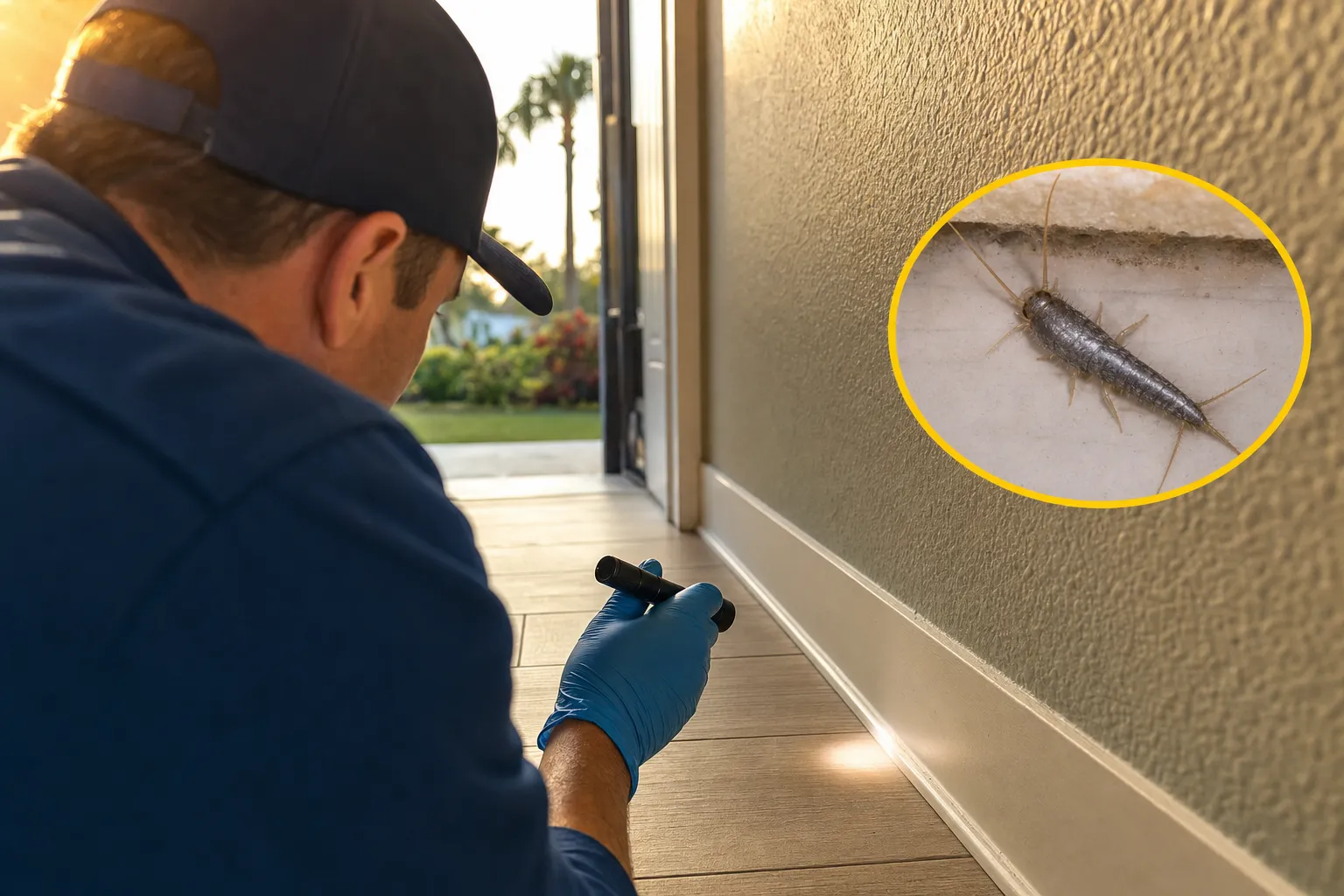
A typical adult is about a third of an inch long. The UF/IFAS silverfish profile (May 2018) gives 0.85 cm, or 0.33 inch, for the common silverfish, Lepisma saccharina. UF/IFAS Extension’s booklice and silverfish fact sheet (ENY-225, revised 2003) puts adults at about one-third to one-half inch. University of California IPM’s silverfish pest note says about 1/2 inch, and adds that one can grow as long as 3/4 inch.
The insect looks longer than those numbers. Per the UF/IFAS fact sheet, silverfish have two long, slender antennae and three long tail-like appendages, each almost as long as the body. Count the tails and a one-third-inch silverfish looks about twice that long.
How big are young silverfish and eggs?
Young silverfish look like small adults. UF/IFAS calls them miniature versions of the adult, and the life stages run from very small to the full third of an inch:
- Eggs: whitish, oval and about 1/32 inch long, per the UF/IFAS fact sheet. Females lay them in secluded places such as behind books or on closet shelves.
- Newly hatched nymphs: about 1/16 inch, plump and white with no scales, according to UC IPM. UC IPM adds that nymphs under 1/8 inch still lack the silvery scales.
- Growing nymphs: UF/IFAS says young silverfish molt six to seven times before they reach the adult stage.
- Adults: about 0.33 inch. They keep molting as adults, 25 to 66 times over a lifespan that can reach four years when conditions suit them, per UF/IFAS.
Growing up takes a while. UF/IFAS says egg to adult typically takes about a year. Eggs hatch in under 20 days at around 90°F and can take up to 40 days at around 72°F, so warm rooms move things along.
Pro tip: Set a cockroach sticky trap along the baseboard overnight, a monitoring tool UC IPM suggests for silverfish. If you catch one, hold the trap next to a ruler, and the size tells you whether you caught a youngster or an adult.
What tiny silverfish in your house mean
Small, pale silverfish are young ones. Silverfish are wingless, so finding several sizes in the same room is a clue that they may be breeding nearby.
Where you find them matters as much as how big they are. UF/IFAS says silverfish usually live in high-humidity areas between about 72°F and 81°F, and indoors they settle into concealed spaces such as bathrooms and attics. They are nocturnal and only rarely seen in daylight unless something disturbs their hiding spot. In a Southwest Florida house, check the bathroom, the laundry room and closet shelves first. UC IPM names laundry rooms, and the UF/IFAS fact sheet names bookcases, closet shelves and the space behind baseboards and door frames.
Write down the date, room and size of each one you catch. A simple record like our pest observation log shows whether the count is climbing and where the source is.
How to tell silverfish from booklice and firebrats
Size helps with booklice. It does not help much with firebrats.
- Firebrats are the same shape and close to the same size. UF/IFAS lists silverfish and firebrats together at about one-third to one-half inch, and UC IPM puts the firebrat at about 1/2 inch. Color is the clue: silverfish are shiny silver or pearl-gray, while firebrats are mottled gray. UF/IFAS says firebrats favor hot, dark places such as around furnaces and fireplaces and in the insulation on hot water pipes.
- Booklice are much smaller. UF/IFAS says most are under one-eighth of an inch and soft-bodied, and they feed mainly on mold. A speck that small on damp, moldy paper could be a booklouse or a newly hatched silverfish. Young silverfish look like small adults, so look for the long antennae and the three tails.
If you are seeing house centipedes on the same walls, that is a separate insect with its own clues. Our post on house centipedes in Southwest Florida homes covers them.
What silverfish damage looks like
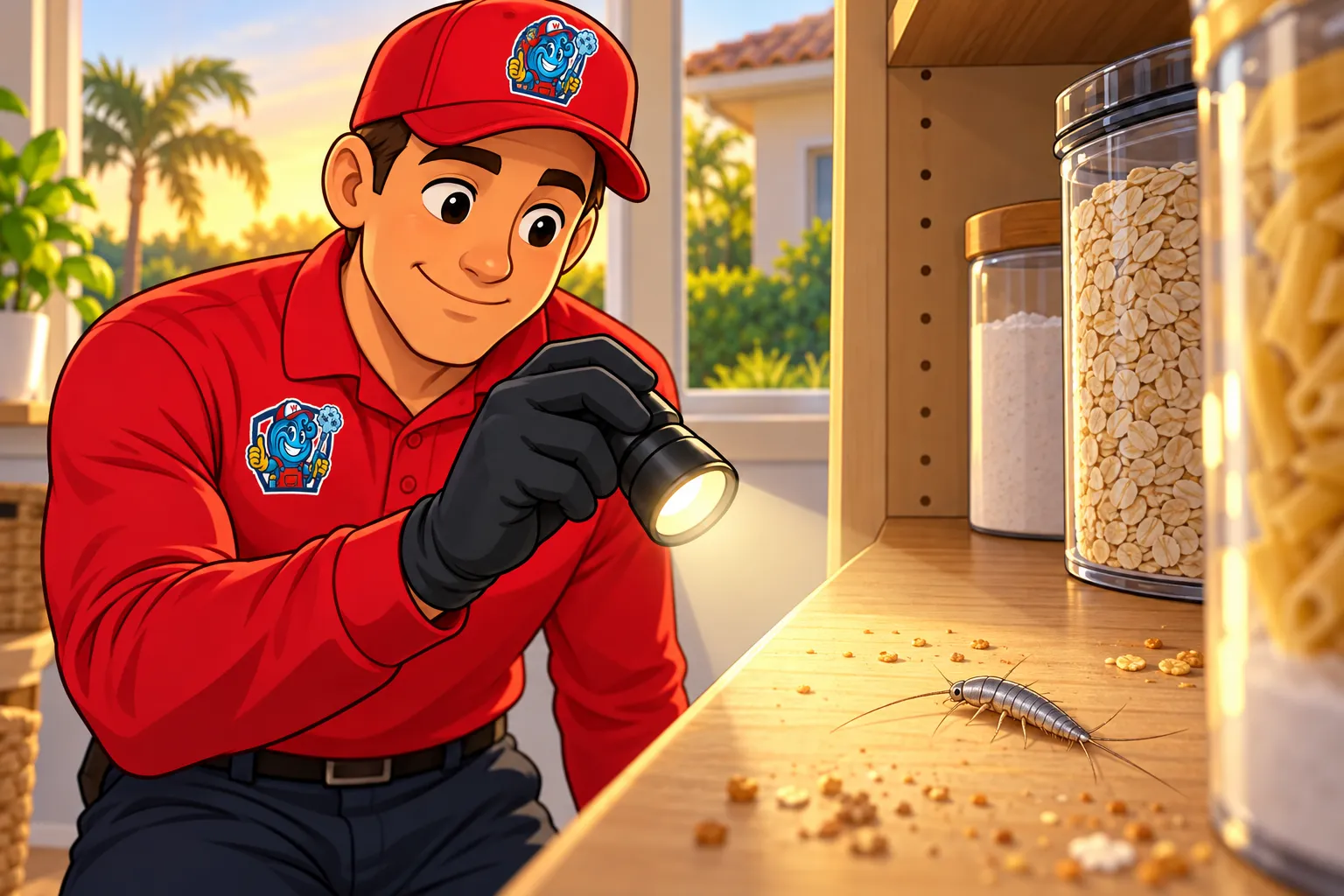
Silverfish eat starch. UF/IFAS lists paper, book bindings, wallpaper glue, cereals, linens, silk and cotton among their foods, and says they have the strongest preference for glossy, starch-coated paper. UC IPM describes the damage on paper and fabric as irregular holes that start in one area and spread, and says pages often discolor from fungi associated with their feeding. UC IPM also notes their jaws are weak enough that they scrape rather than bite.
How to check for silverfish without a spray
Start with moisture and hiding places. These steps come from the UF/IFAS silverfish profile and UC IPM:
- Find the damp room. UF/IFAS says reducing humidity may reduce the silverfish population in that spot. Run the bathroom fan, fix drips and keep laundry rooms ventilated.
- Vacuum and seal. UF/IFAS lists vacuuming, sealing holes and cracks where silverfish are found, and removing standing water.
- Move the paper. Get cardboard boxes, old magazines and stored paper out of cool, damp spots.
- Monitor. UC IPM suggests small glass jars wrapped on the outside with masking tape. Silverfish climb the tape, fall in and cannot climb the slick glass. Set them in corners and along edges overnight.
- Store food tight. UC IPM recommends containers with tight lids for dry, processed food.
What not to do
- Don’t assume they will starve out fast. UF/IFAS says silverfish can go up to a year without food.
- Don’t spray the baseboards and skip the moisture. UF/IFAS ties silverfish to humid spots, and a spray leaves the damp closet or leaky drain as it was.
- If you use an insecticide labeled for silverfish, read and follow the product label, keep the product off food-preparation and food-contact surfaces, and place it out of sight and reach of children and pets.
When to call a professional
Call when you keep catching silverfish after the room is dry, when you find several sizes in the same area, or when you see fresh damage on stored paper, books or clothing. Bring your notes on where and when you found them, plus one in a sealed bag if you caught it.
How Waves Pest Control approaches the problem
A Waves Pest Control visit starts with a walk of the property to identify where the activity is, including the slab line, soffits and eaves, and treats indoors on spots with active pressure. Homeowners from Sarasota to Venice can see local service on our pest control in Sarasota and pest control in Venice pages. If you want ongoing service, compare WaveGuard memberships, or get a pest control estimate for your home.
Frequently Asked Questions
Is it bad if you find a silverfish?
One silverfish is a clue about conditions more than an emergency. UF/IFAS says they live in humid spots and feed on starchy materials like paper and fabric, so check the room for moisture and stored paper.
Can silverfish live in your bed?
UF/IFAS lists linens, cotton and silk among their foods, so stored bedding can be damaged. They hide by day and scrape rather than bite, per UC IPM, so bites you wake up with are a reason to look for a different pest.
Do silverfish die off without treatment?
Not quickly. UF/IFAS says they can go up to a year without food and live up to four years in good conditions, so drying out the room and removing their food works better than waiting.