Jump to a section (9)
- 01Roaches or beetles: what to check first
- 02Do beetles eat cockroaches?
- 03What is a cockroach’s worst enemy?
- 04Why natural enemies will not fix an indoor infestation
- 05Why shouldn’t you squish a roach?
- 06Checks you can do at home
- 07What not to do
- 08When to call a professional
- 09How Waves Pest Control handles roach and beetle calls
A shiny dark bug runs across the kitchen tile at night, and two questions follow it. Is that a roach or a beetle? And if it’s a beetle, is it eating the roaches? This guide sticks to what UF/IFAS publishes about Florida cockroaches and the animals that attack them. For the full side-by-side ID, read our beetle or cockroach guide for Southwest Florida. If you would rather hand the problem off, our pest control services page explains what a visit covers.
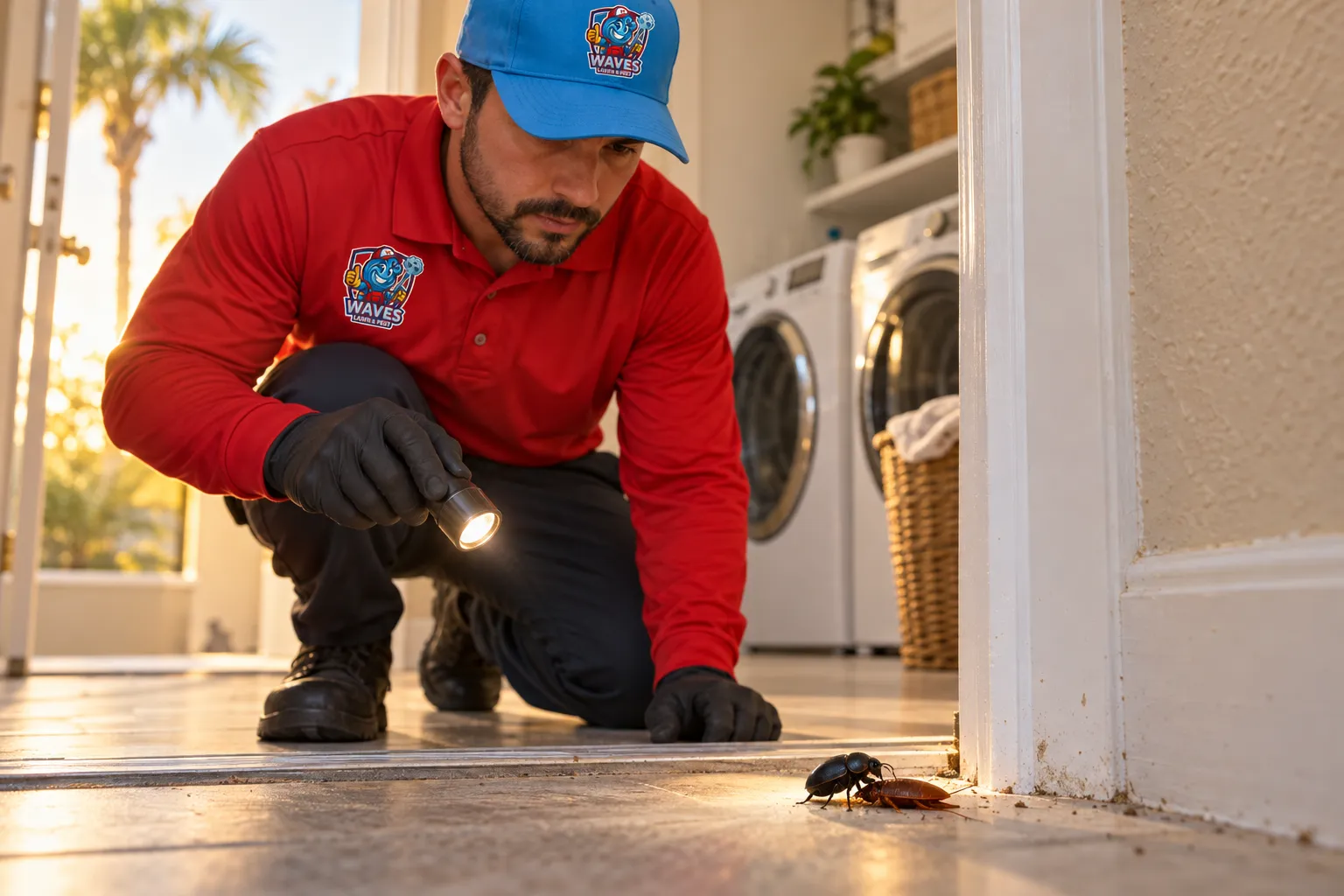
Roaches or beetles: what to check first
Wings, size and speed give the quickest clues. A beetle’s front wings are hardened protective covers called elytra, according to a 2023 review of beetle wing evolution in the journal Biology Letters, hosted by the National Library of Medicine. UF/IFAS describes the common Florida roaches this way:
- American cockroach. About 1.5 inches long and reddish brown, with a pale brown or yellow band around the edge of the shield behind the head. The male’s wings reach past the tip of the abdomen and the female’s do not, per the UF/IFAS American cockroach profile.
- Florida woods cockroach. 1.2 to 1.6 inches long and reddish brown to nearly black. Its wings are short leathery pads that barely meet down the middle and leave the abdomen bare, and it moves slowly, per the UF/IFAS Florida woods cockroach profile. That page lists Charlotte County among its Florida records.
- German and Asian cockroaches. Small, with adults seldom more than 5/8 inch long, per UF/IFAS Cockroaches and Their Management. The Asian cockroach flies to porch lights.
Short wing pads, a dark body and an unhurried walk can make the Florida woods cockroach look more like a beetle than the fast, winged roach most people picture. Treat every feature here as a clue. To confirm, trap the bug under a clear cup or take a sharp photo and compare it with our pest library, or ask a professional to look at it.
Want a number before you decide what to do? Get a pest control estimate online.
Do beetles eat cockroaches?
Not in a way that will help with a roach problem. A UF/IFAS Brevard County Extension article on beneficial insects describes ground beetles as night hunters that feed on landscape pests such as mole crickets and caterpillars. They hide under stones, logs, leaves and bark during the day. The UF/IFAS American cockroach profile lists parasitic wasps as the natural enemies found for that roach and names no beetles.
A beetle on your floor has its own causes. Our guide to beetle-type insects in Southwest Florida covers the pantry, wood and fabric beetles that end up indoors.
What is a cockroach’s worst enemy?
The most specialized enemies UF/IFAS describes are tiny wasps that lay their eggs inside cockroach egg cases. Large hunting spiders also take roaches.
Wasps that attack roach egg cases
UF/IFAS says the wasp Aprostocetus hagenowii lays its eggs in the American cockroach’s egg case, which keeps the roach nymphs from emerging. The UF/IFAS profile of the ensign wasp, Evania appendigaster, adds detail on a second egg-case wasp:
- It is all black, with a front wing 5.5 to 7.0 mm long (about 1/4 inch), and its small abdomen sits up high like a little flag.
- A female lays one egg in a roach egg case, and the larva eats all of the roach eggs inside.
- It is common in much of the southern US, and adults are occasionally seen in buildings and homes.
- UF/IFAS says the adults are not known to sting humans.
Neither wasp works on every roach. UF/IFAS says ensign wasps are ineffective against the Florida woods cockroach because of its size, and a different wasp specializes on that species.
Pro tip: A small black wasp with a flag-shaped abdomen on a window sill may be an ensign wasp. It grows up inside cockroach egg cases, so treat it as a clue that roaches may be breeding nearby, and check dark, damp spots under sinks and behind appliances.
Large hunting spiders
UF/IFAS says the huntsman spider, Heteropoda venatoria, is valued in tropical countries because it catches and feeds on cockroaches and other household insects. It hunts without a web. Per the UF/IFAS huntsman spider profile, adults have a body about an inch long and a leg span of 3 to 5 inches, and the spider turns up in and around homes. UF/IFAS calls it not dangerous, though it can give a painful bite to someone who handles it or traps it, for example in a shoe.
Why natural enemies will not fix an indoor infestation
UF/IFAS reports that ensign wasp parasitism reached 29 percent in American cockroach populations in the Middle East, with no data for the United States. Aprostocetus hagenowii reached a maximum of 57 percent. Meanwhile a female American cockroach at her peak can form two egg cases a week, each holding about 16 eggs.
Sprays work against the helpers too. The UF/IFAS American cockroach profile notes that insecticides used against cockroaches may kill off the parasitic wasps. UF/IFAS recommends an integrated pest management plan: exclusion, removing water, food and hiding places, and targeted baits. It calls chemical use alone the least effective method.
Why shouldn’t you squish a roach?
Crushing a roach spreads the parts that cause trouble. UF/IFAS lists cockroach droppings, shed skins and body parts such as antennae and legs as allergens that can cause rashes and other allergic reactions in sensitive people. It recommends vacuuming to remove skins and droppings, and scrubbing droppings with hot, soapy water. Those droppings carry a chemical that draws more roaches to the spot.
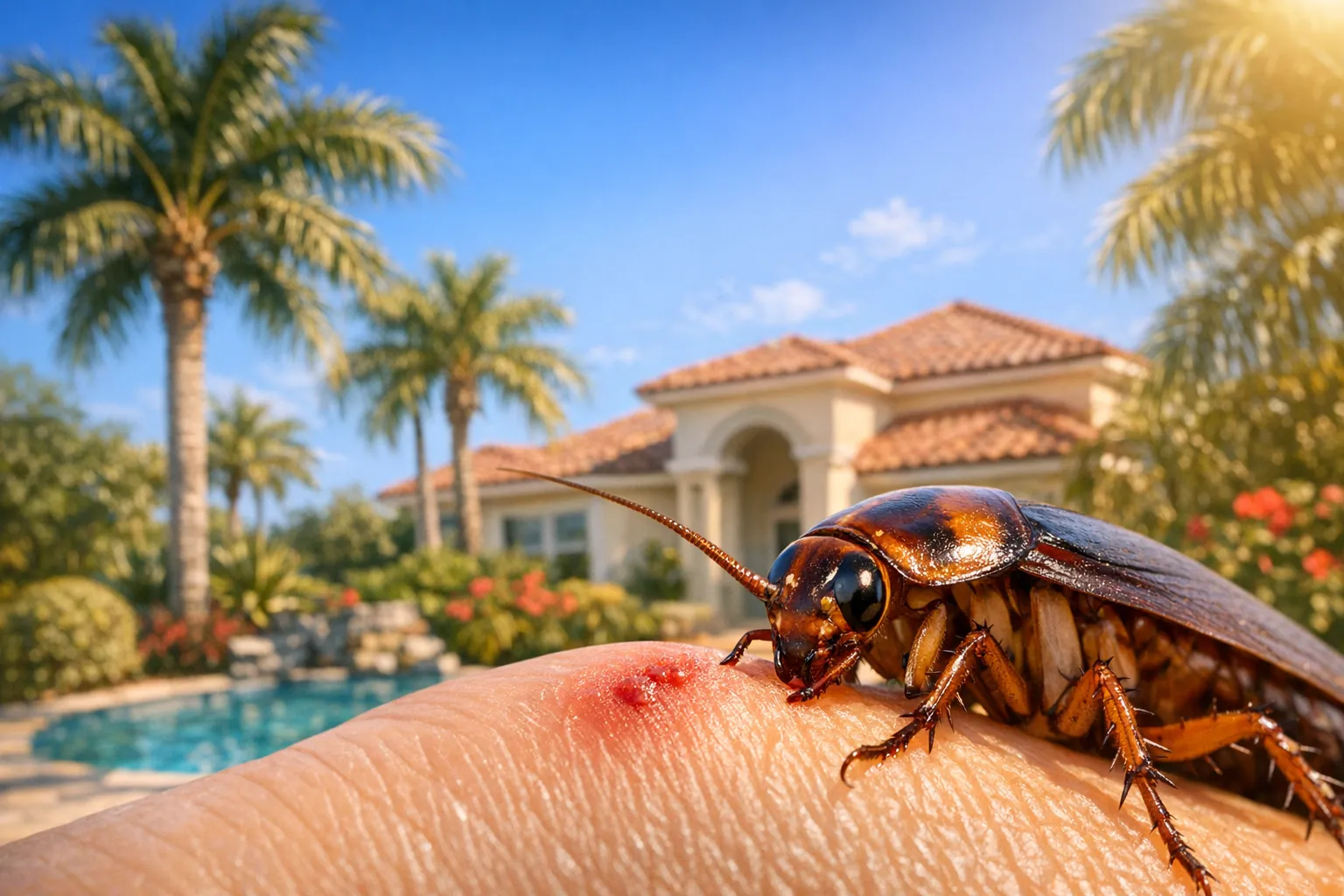
The Florida woods cockroach adds its own reason to keep your hands off. UF/IFAS says the adult sprays an oily, smelly defensive liquid that irritates skin and eyes, from as close as 3 centimeters to as far as about 1 meter (roughly 3 feet). Use a vacuum hose and wash your hands afterward. If you have symptoms you think come from roaches, see a doctor. Wondering about bites as well? Our post on whether cockroaches bite covers that question.
Checks you can do at home
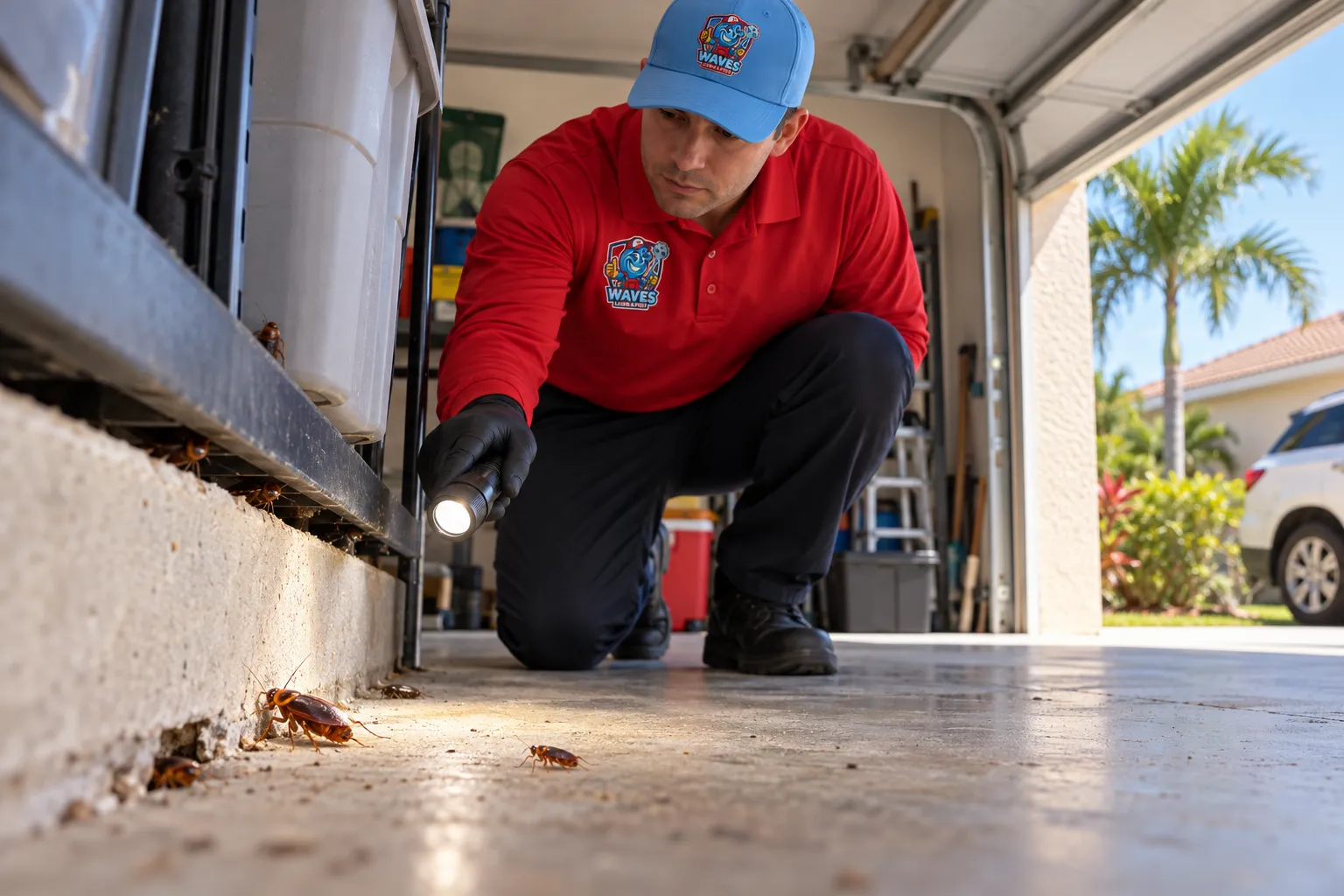
- Look where roaches hide. UF/IFAS names the kitchen sink, inside and under cabinets (especially upper corners), behind drawers, around pipes, behind loose baseboards and the bathroom.
- Look for egg cases. An American cockroach egg case is about 1/3 inch long, brown at first and black within a day or two, and is left near a food source, sometimes glued to a surface, per UF/IFAS.
- Check moisture. UF/IFAS calls water the most important factor in cockroach survival. Fix leaks, empty refrigerator drip pans and don’t leave water standing in the sink.
- Check the mulch. UF/IFAS says the large outdoor roaches breed heavily in pine straw mulch and poorly in gravel or bare soil, and suggests only a thin layer of mulch extending 1 foot out from the foundation.
UF/IFAS also notes that outdoor cockroaches do not survive well indoors, and removing a stray from the house is often all it takes.
What not to do
- Don’t count on a fogger. UF/IFAS says a fogger only affects the roaches the fog directly touches, so results vary.
- Don’t spray where baits sit. Per UF/IFAS, a liquid insecticide near bait repels roaches from the bait.
- Don’t treat before you identify. UF/IFAS recommends small bait stations for German cockroaches and large ones for the big outdoor roaches, so the species decides the setup. If you use a bait, read and follow the product label, keep it off food-preparation surfaces, and place it out of sight and reach of children and pets.
- Don’t grab a Florida woods cockroach by hand. Its spray can reach your eyes.
When to call a professional
- You see small roaches in the kitchen or bathroom. UF/IFAS says German cockroaches usually live there and can have several generations a year.
- You find egg cases or shed skins indoors.
- Big roaches keep coming up through drains.
- Roaches keep turning up after you have fixed leaks and food sources.
How Waves Pest Control handles roach and beetle calls
Our approach starts with identification. The large outdoor roaches people call palmetto bugs live in mulch, woodpiles, soffits and tree holes, and finding one inside is not a sign of a dirty house. The German cockroach is an indoor roach, and American cockroaches often get in through sewers and drains. Each of those calls for a different plan.
A first visit from Waves Pest Control includes a walk around the property to find active pest pressure, a look at the soffits, eaves and slab line, a perimeter treatment, and interior spot treatment where pests are active. Products go on according to their EPA labels. Ongoing coverage runs through WaveGuard memberships, and WaveGuard plans include unlimited callbacks between scheduled visits at no extra charge. If covered pests come back between visits, Waves comes back free.
If you live in Sarasota or Port Charlotte, our Sarasota pest control page and Port Charlotte pest control page cover local service. Anywhere else in Southwest Florida, get a pest control quote online in about a minute.