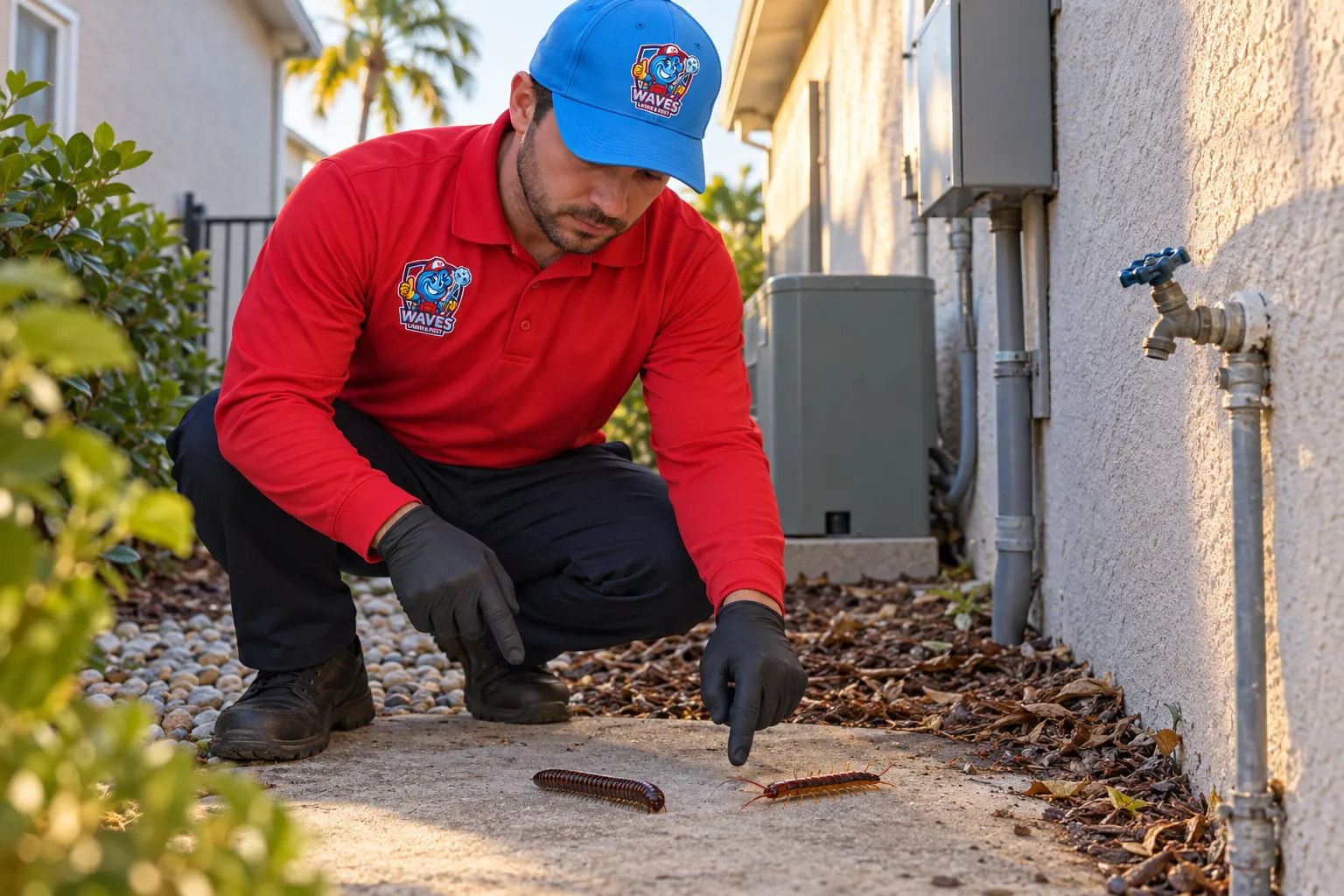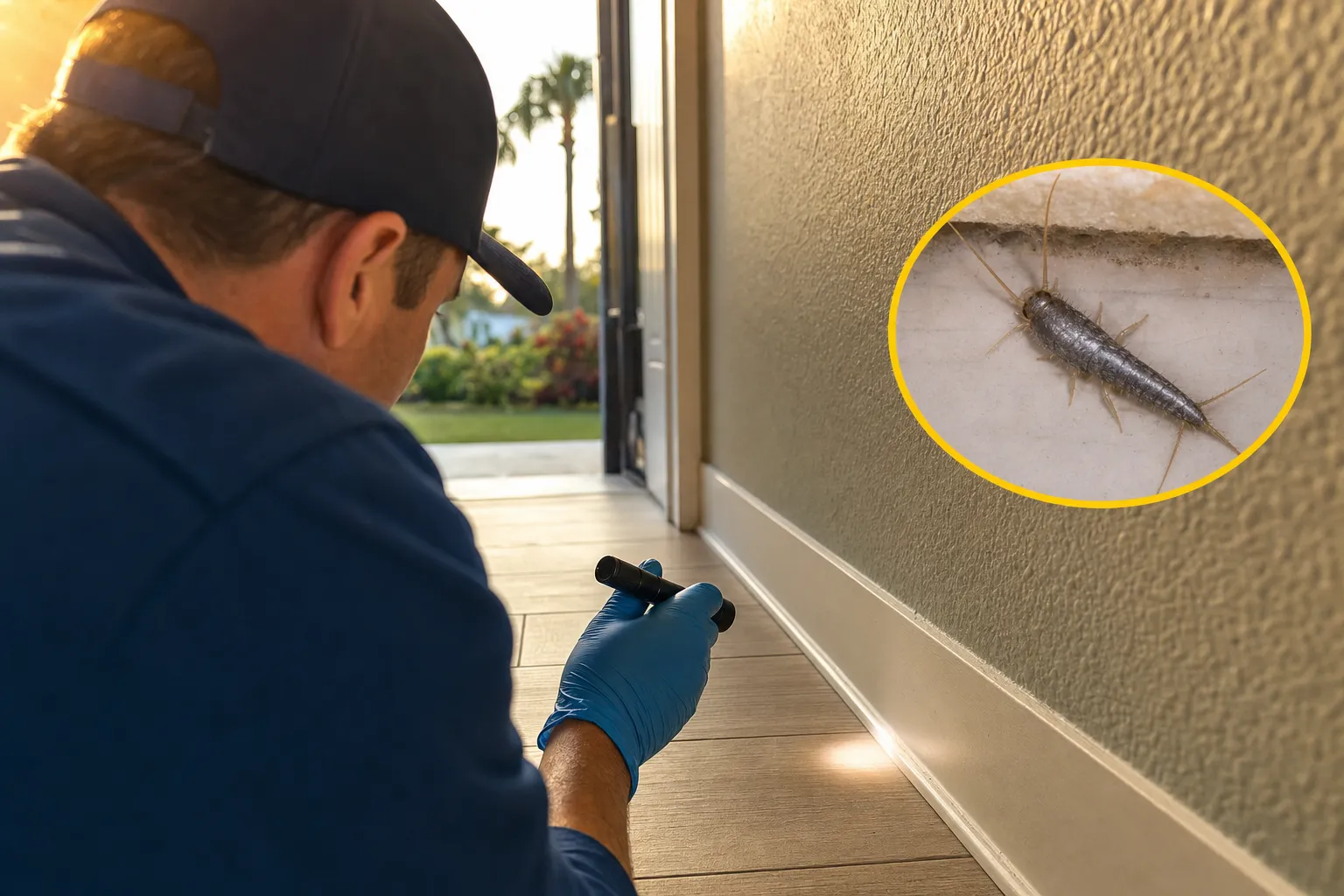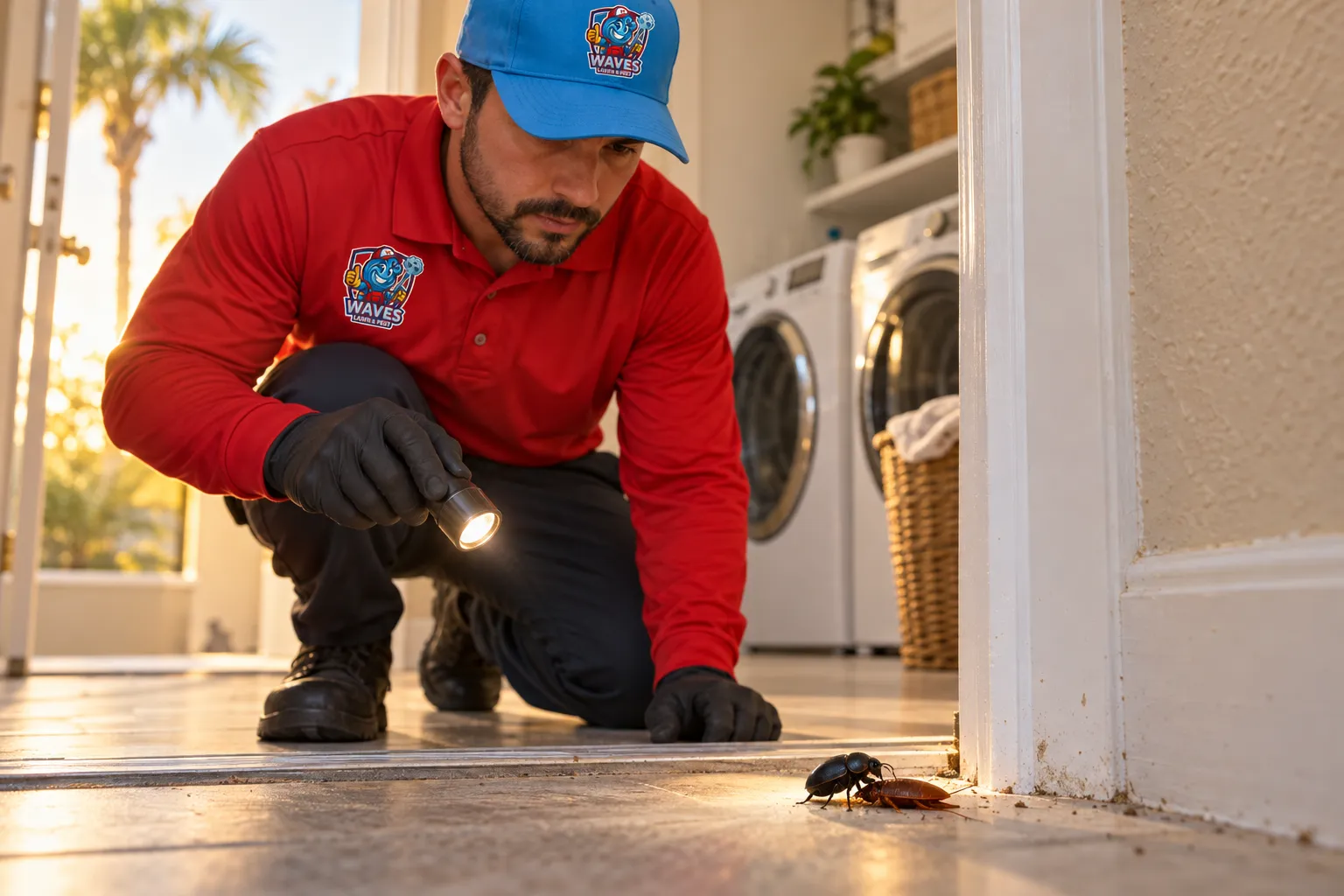
The dark, curled-up “worms” on the lanai after a storm are usually millipedes, and in Southwest Florida they come in a few kinds. UF/IFAS Extension offices around the state have written about the species homeowners here find, which ones are invasive, and why they march into garages after heavy rain. This guide shows how to identify the common species and covers what to do. For the wider list of what a visit can handle, see our pest control services page.
Seeing dozens a night and want a number before you decide? Get a pest control quote online.
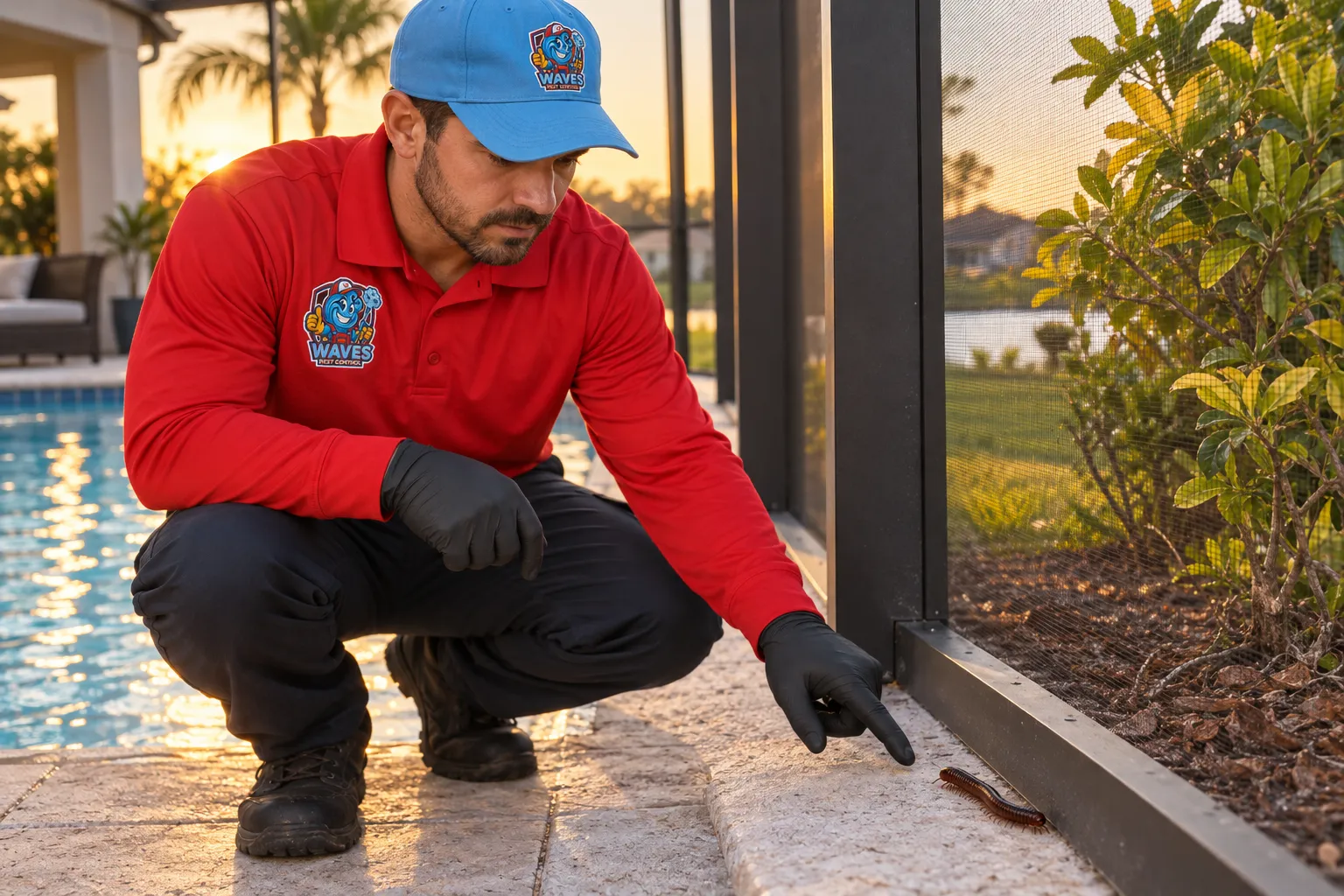
Which millipedes live in Southwest Florida?
UF/IFAS Extension in Sarasota County names the bumblebee millipede, the rusty millipede and the Florida ivory millipede as the most common in the state, and says the first two are invasive while the ivory millipede is native, in its post on millipedes.
All three share the millipede body plan: a long, round, segmented body with two pairs of legs on most segments. The Sarasota post puts the usual leg count anywhere from 40 to 400, depending on the species.
The bumblebee millipede
The Sarasota County post lists the bumblebee millipede under its scientific name, Anadenobolus monilicornis, and counts it among the invasive species. UF/IFAS Extension in Charlotte County writes about two newer invasive millipedes, which it calls the yellow-banded millipede and the rusty millipede, in its 2022 post on millipede migrations.
The rusty millipede
The rusty millipede, Trigoniulus corallinus, is the other invasive species. The Charlotte County post describes these as worm-like animals several inches long and gives the rusty one a dark orange color.
The Florida ivory millipede
The Florida ivory millipede, Chicobolus spinigerus, is the native one. UF/IFAS Extension in Indian River County describes it as nearly 2 inches long, with a cylindrical, segmented body that coils up when disturbed, in its post on millipedes. A later Sarasota County Extension post says it prefers somewhere moist but not flooded, lives under rocks and logs and in the upper layers of soil, and is a favorite in the pet millipede trade for its coloring and tame behavior, in its Bug Bungalows post.
If the animal you found runs fast on one pair of legs per segment, it is a centipede. Our post on centipedes in Southwest Florida homes covers the one most people find indoors.
Are there poisonous millipedes in Florida?
Florida millipedes are not venomous, and they do not bite or sting. UF/IFAS Extension in St. Lucie County says exactly that in its September 2026 post on fall millipedes, and adds that they cause no structural damage inside the home, though they may leave stains if crushed.
Their defense is chemical. The Sarasota County post says some species emit a defensive compound that contains trace amounts of hydrogen cyanide, which is not deadly but can irritate skin. The Indian River County post says the ivory millipede may give off a foul odor when disturbed and calls these millipedes harmless to pets, humans and furniture.
In practice:
- Pick them up with a broom and dustpan, or a paper towel, and skip bare hands.
- Wash your hands if you touched one.
- Sweep them up gently instead of stepping on them on light-colored tile or grout, where a crushed one can leave a stain.
Why are millipedes in my house in Florida?
Wet soil pushes them out. The Sarasota County post explains that rain or irrigation fills the air gaps in the soil, which makes it hard for soil-dwelling animals to breathe, so millipedes move out to find drier ground. In Sarasota, the rainy season runs from June through October, and the Charlotte County post ties millipede moves to the rains of summer.
That post says summer rains push millipedes to higher ground, where they climb walls and enter garages and lanais. It also notes that millipedes periodically emerge in large numbers and migrate, and that researchers do not know why. The Indian River County post adds the entry points: cracks in the walls, the track under sliding glass doors, and gaps around windows and doors.
Inside, they do not last. The Charlotte County post says millipedes cannot tolerate a dry environment for long, so a cooled, dry house is a poor place for them to stay. The St. Lucie County post says they feed mainly on decaying organic matter, and the Sarasota post calls them detritivores that break down leaves, wood and fruit. Your kitchen has little for them.
How to get rid of millipedes in the house and yard
Start outside, because the source is the wet soil and mulch at the foundation. These steps come from the UF/IFAS Extension posts above:
- Sweep or vacuum the ones indoors. The Sarasota County post suggests a broom and dustpan and moving them outside, and the St. Lucie County post suggests a vacuum.
- Pull mulch away from the house. The Indian River County post says mulch should not touch the house and suggests rock or stone over a landscape weed barrier, or bare soil from the house to the drip line.
- Water less. The St. Lucie County post lists overwatering the landscape as something to avoid, since wet soil is what drives them toward the slab.
- Close the gaps. Fit door sweeps, check that doors and windows close tightly, and seal cracks around the foundation, doors and windows, per the St. Lucie and Charlotte County posts.
Pro tip: The evening after a heavy rain, walk around the outside of the house with a flashlight. Check the slab line, the sliding glass door track and the bottom seal of the garage door. The spots where millipedes bunch up show you which gap or which mulch bed to fix first.
Sprays have a limited role. The Charlotte County post calls perimeter pesticides that list millipedes on the label a temporary measure, so they work best alongside the mulch, water and sealing steps above. If you use a store product, read the label and follow it exactly.
When the millipedes keep coming back
A few millipedes after a heavy rain fits the pattern the Charlotte County post describes. A wave that returns after every rain usually points to soil that stays wet against the slab, or to gaps you cannot see from inside.
Our approach at Waves Pest Control starts at the slab line. A first visit includes a walk around the property to find active pest pressure, a look at the soffits, eaves and slab line, and a perimeter treatment, with products applied according to their EPA labels. If you manage rentals or an HOA, our pest observation log for property managers helps you record which buildings get hit after each rain.
Frequently Asked Questions
What millipedes are in Florida?
UF/IFAS Extension in Sarasota County names the bumblebee millipede, the rusty millipede and the Florida ivory millipede as the most common in Florida. The first two are invasive and the ivory millipede is native.
Can millipedes hurt my dog or cat?
UF/IFAS Extension in Indian River County calls millipedes harmless to pets, humans and furniture. Some species release a fluid that can irritate skin, so call your veterinarian if your pet seems uncomfortable after mouthing one.
Will millipedes live inside my house?
UF/IFAS Extension in Charlotte County says millipedes cannot tolerate a dry environment for long. They live and feed in moist soil and mulch outdoors, which is where to focus control.
Get help in your area
If millipedes keep lining up at the same doors after every rain, see what pest control in Sarasota or pest control in Bradenton from Waves Pest Control includes. Ongoing service plans are on the WaveGuard memberships page, and you can compare other common bugs in our pest library.