Last updated: November 2026.
You step out the front door of your Southwest Florida home after dark and walk face first into a web close to 2 feet across, with a big brown spider parked in the middle. That spider is often an orb weaver. UF/IFAS describes the spotted orb weaver and its close relative as common and conspicuous in the moist woodlands of much of Florida. Here is how to identify one, how much of a bite risk it is, and what to do about the web. For what a pest visit covers, see our pest control services page, or get a pest control quote online if the webs are more than you want to deal with.
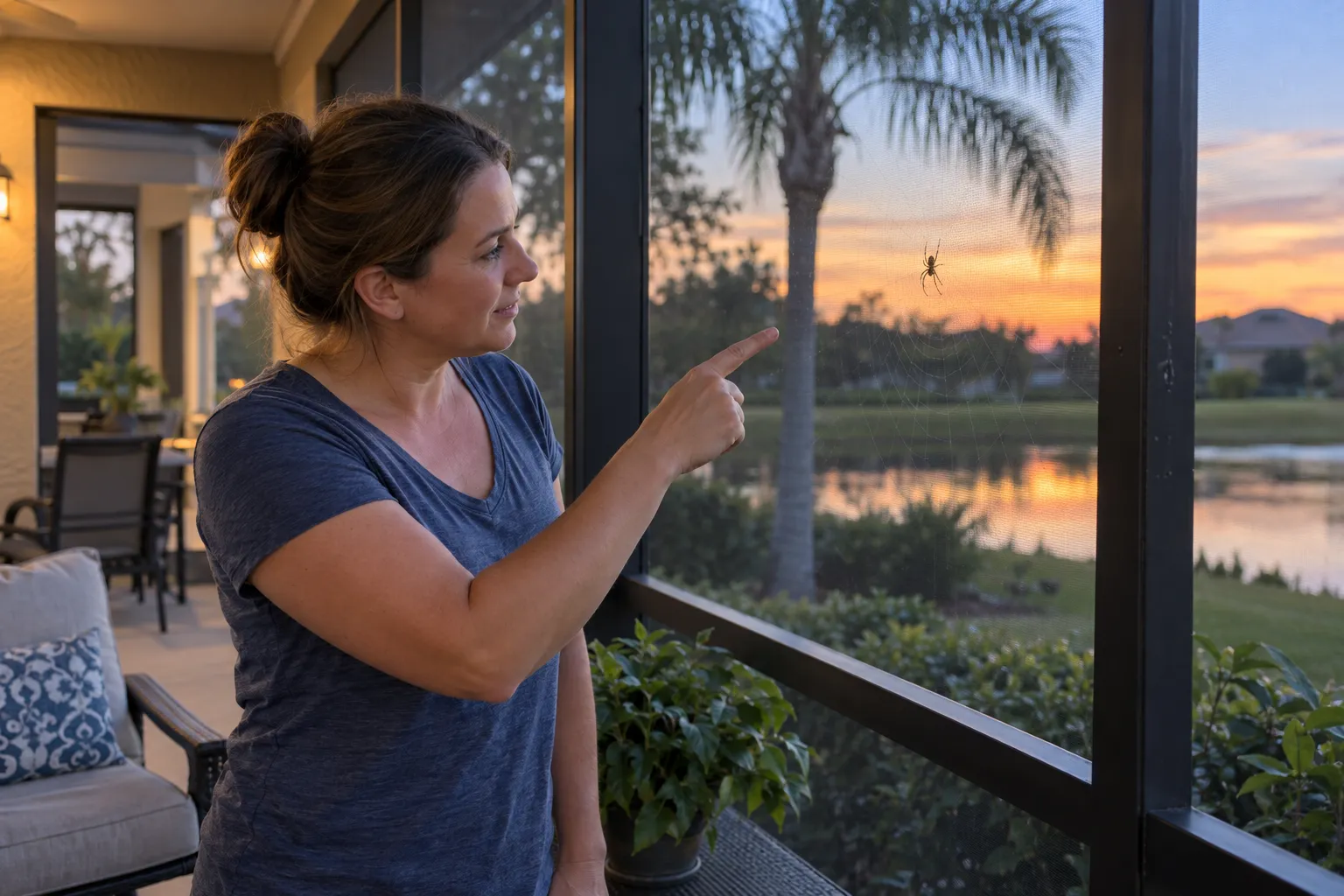
Unless another source is named, the species facts here come from the UF/IFAS profile of both species (EENY-316, updated June 2024).
What this orbweaver looks like
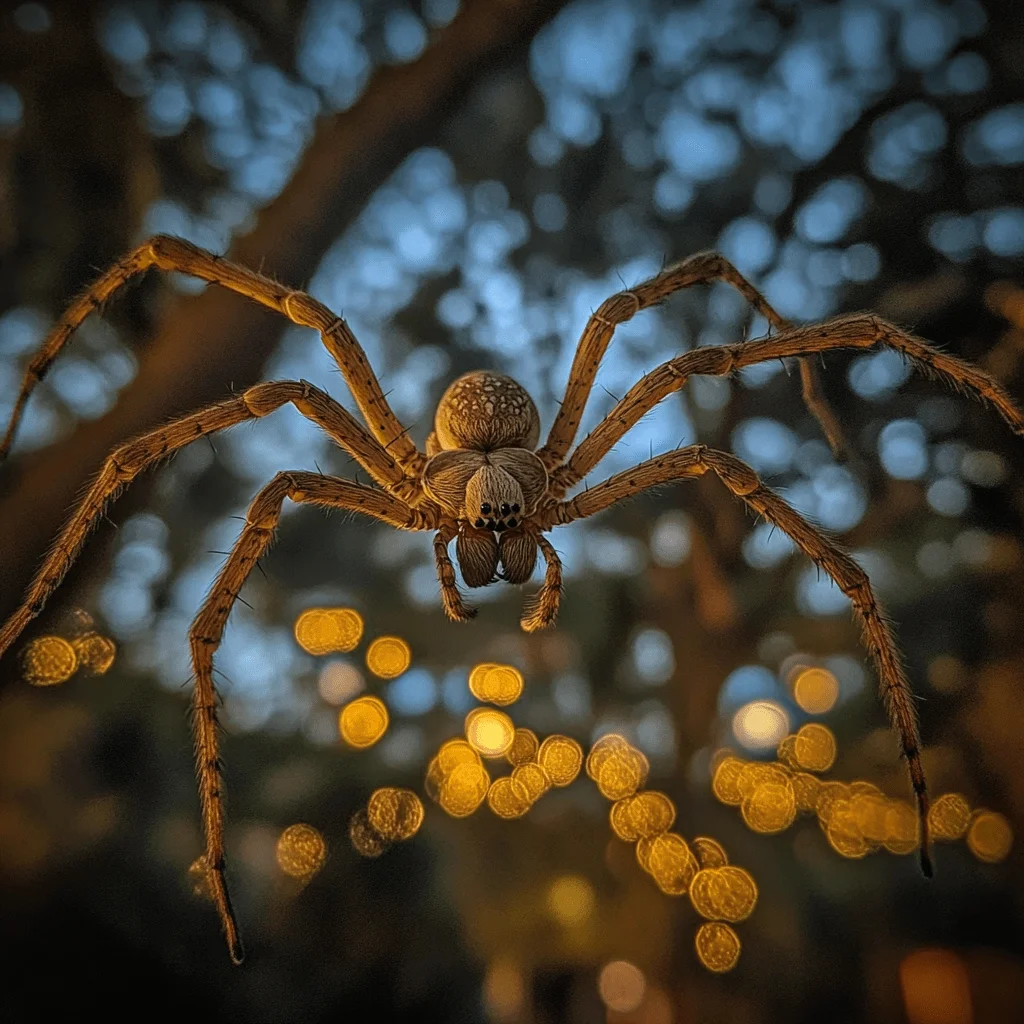
The spotted orb weaver is a big, mostly brown orb weaver with banded legs. Missouri’s Department of Conservation lists spotted orbweaver among the common names of Neoscona crucifera, along with barn spider and Hentz orbweaver. UF/IFAS profiles it with a similar species, N. domiciliorum, and tells them apart this way:
- N. crucifera. The larger and more common of the two, with drab coloring. Females are reddish-brown to brown. Males are lighter brown, with the sides of the front body section nearly black.
- N. domiciliorum. Females have a bright white or grayish-yellow top of the abdomen, with a wide black stripe down each side.
- Both species. A double row of black slash marks runs along the back half of the abdomen, though the marks are sometimes hard to see. The legs are banded with reddish-brown and pale yellow, the striped-leg look people notice first. The upper leg segment, the femur, is brown on N. crucifera and red on N. domiciliorum.
Size helps too. UF/IFAS gives female N. crucifera a body length of 8.5 to 19.7 mm, about 1/3 to 3/4 inch, and says Florida specimens usually fall in the upper part of that range, which makes it one of the largest orb-weaving spiders in the state. Female N. domiciliorum run 7.2 to 16.2 mm, about 1/4 to 2/3 inch.
Where you find the orbweaver spider
Look up at the eaves, especially near a light. UF/IFAS says both species are often found on or near buildings, with the edge of an eave as the top anchor, the bottom lines running to a shrub or the ground, and a simple silk retreat under the eave as the daytime shelter. A shrub bed under the soffit can put that web right across your path.
Light matters too. Missouri’s Department of Conservation says these spiders often build near dusk-to-dawn lights to catch the flying insects the light draws. UF/IFAS adds that people may not know the spiders are there until they see a web in a lighted area after dark, or walk into one.
The orb of an N. crucifera web may be nearly 2 feet (60 cm) across, per UF/IFAS, and N. domiciliorum webs usually run somewhat smaller. UF/IFAS gives N. crucifera a wide range, from the Okeechobee area of southern Florida north to the northeastern states and southwest to Arizona and central Mexico.
When these spiders show up in Florida
Late summer and fall are when you notice the adults. UF/IFAS says that in Florida, adults usually are not apparent until late August, and that in the fall, adult females can be found sitting head down in the hub of the web during daylight hours.
Young spiders keep night hours. They usually build a vertical web around dusk and take the orb down shortly after dawn, then spend the day in a retreat of curled leaves tied with silk. Adult females often leave their webs up and hunt during the day. Missouri’s guide says the female eats her web at dawn and spins a new one at dusk, so a web you sweep away in the morning, or one torn by wind or rain, can be back by the next night.
The seasonal notes Waves Pest Control keeps for its service area list October and November as the months when spider activity shows on exterior lights and porches.
Is the orbweaver spider dangerous?
Not in any serious way. UF/IFAS says bites from these spiders are not known to cause serious effects to humans. Missouri’s Department of Conservation says orbweavers do not bite unless molested and that their bites are not dangerous.
They do carry venom, like most spiders. The UF/IFAS guide to common and charismatic Florida spiders (ENY2080, February 2023) names the widow spiders as the only spiders native to or established in Florida with medically significant venom, meaning a bite could require medical care.
Any spider bite still deserves first aid. The CDC first aid steps for spider bites are to wash the area with soap and water, put a cold, damp cloth or a cloth filled with ice on it to reduce swelling, and raise the area if you can. MedlinePlus says to watch the spot over the next several days for signs of infection such as increasing redness, swelling or pain. See a doctor if those signs appear. Get emergency care right away for trouble breathing, swelling of the face or mouth, throat tightness, or fainting.
How to tell it from other Florida spiders
Start with the web. UF/IFAS describes orb webs as flat, circular webs that resemble wheels. A messy cobweb in a sheltered corner is the kind widow spiders build, per the UF/IFAS gardening guide to Florida spiders. After the web, check the body and the legs.
- Golden silk orb-weaver, often called the banana spider. The UF/IFAS gardening guide says females are 24 to 40 mm long, with yellow spots on a dull orange to tan, cylindrical body and brown-and-orange banded legs, in a web of golden silk. See our guide to banana spiders in Southwest Florida.
- Garden orb weavers (Argiope). UF/IFAS names four species in Florida, often with a zigzag silk band called a stabilimentum in the web, and says they pose no threat to humans.
- Spiny-backed orb weaver. A crab-shaped abdomen with spines, white with red spines to yellow with black, per the gardening guide. The UF/IFAS profile of the spiny orb weaver says it is not as large as some other common orb weavers, Neoscona among them.
- Tropical orb weaver (Eriophora ravilla). The closest match after dark. The UF/IFAS profile of the tropical orb weaver says females are 12 to 24 mm long and, in Florida, typically reddish-brown in front with a gray to brown abdomen. It builds after dark, takes the orb down before dawn, and unlike Neoscona is not conspicuous by day as an adult. Its bites are not known to cause serious effects to humans.
- Widow spiders. A different web and a different risk. The gardening guide describes messy cobwebs in shrubs, building corners, entryways, under eaves and lawn furniture, and in outdoor trash cans, plus a red or orange hourglass under a bulbous abdomen. It says to seek medical care if you suspect a widow bite. Our post on black widow vs brown widow explains how to tell those two apart.
Still not sure? The UF/IFAS gardening guide suggests your county UF/IFAS Extension office for help identifying a spider, and the Waves pest library covers other common pests.
What to do about a web by your door
Most of the time, you can leave it, since UF/IFAS calls these spiders beneficial insect eaters. When a web is in your way:
- Identify it first. Look from a few feet away with a flashlight after dark. Check the web shape and leg bands before you reach toward it.
- Sweep the web down. A broom or long-handled duster keeps your hand away from the spider. The web may return by the next night.
- Cut back on the light. Turn off porch lights and dusk-to-dawn fixtures you do not need. These spiders build near lights to catch the insects drawn there, so a darker doorway can give them less to catch.
- Keep hands out of dark corners. Widows use the same eaves, entryways and lawn furniture. The gardening guide says widow bites sometimes happen when someone grabs the spider by accident, picking up a flowerpot or a trash can handle, or sticks a hand into a dark corner. Wear gloves for that kind of yard work.
Pro tip: Check for webs at night with a flashlight. UF/IFAS says young spotted orb weavers usually take their webs down shortly after dawn, so a daytime look at the eaves can miss them.
What not to do
- Do not pick up the spider or brush it off with a bare hand. Missouri’s guide says orbweavers do not bite unless molested.
- Do not assume every big web spider by the door is harmless. Check for the messy cobweb and hourglass of a widow first.
When to call a professional
Call a pro when webs line many eaves night after night, when you cannot tell an orb weaver from a widow, or when you find messy cobwebs with an hourglass spider near doors, play areas or trash cans. A professional inspection can sort out which spiders are building the webs.
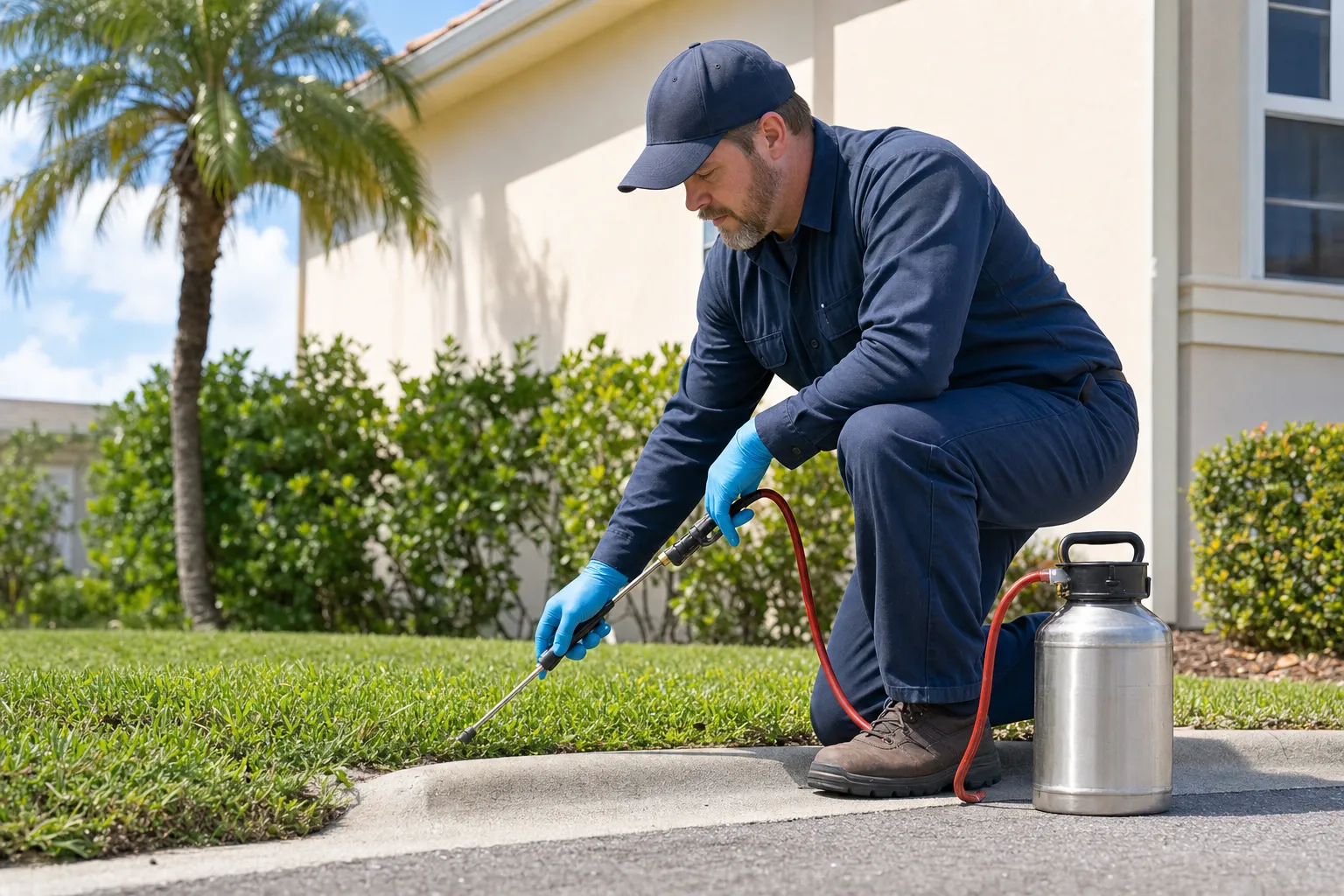
Waves Pest Control starts with identification, because most web spiders around a house are beneficial. An initial visit includes a walk around the property, a look at the soffits, eaves and slab line, and de-webbing at the entries. Recurring quarterly visits include de-webbing and an exterior perimeter treatment. If you want that on a schedule, WaveGuard memberships explain how the recurring plans work.
Ready to talk it through? Request a pest control quote for your Sarasota home, or start with our Bradenton pest control page if you live in Bradenton.