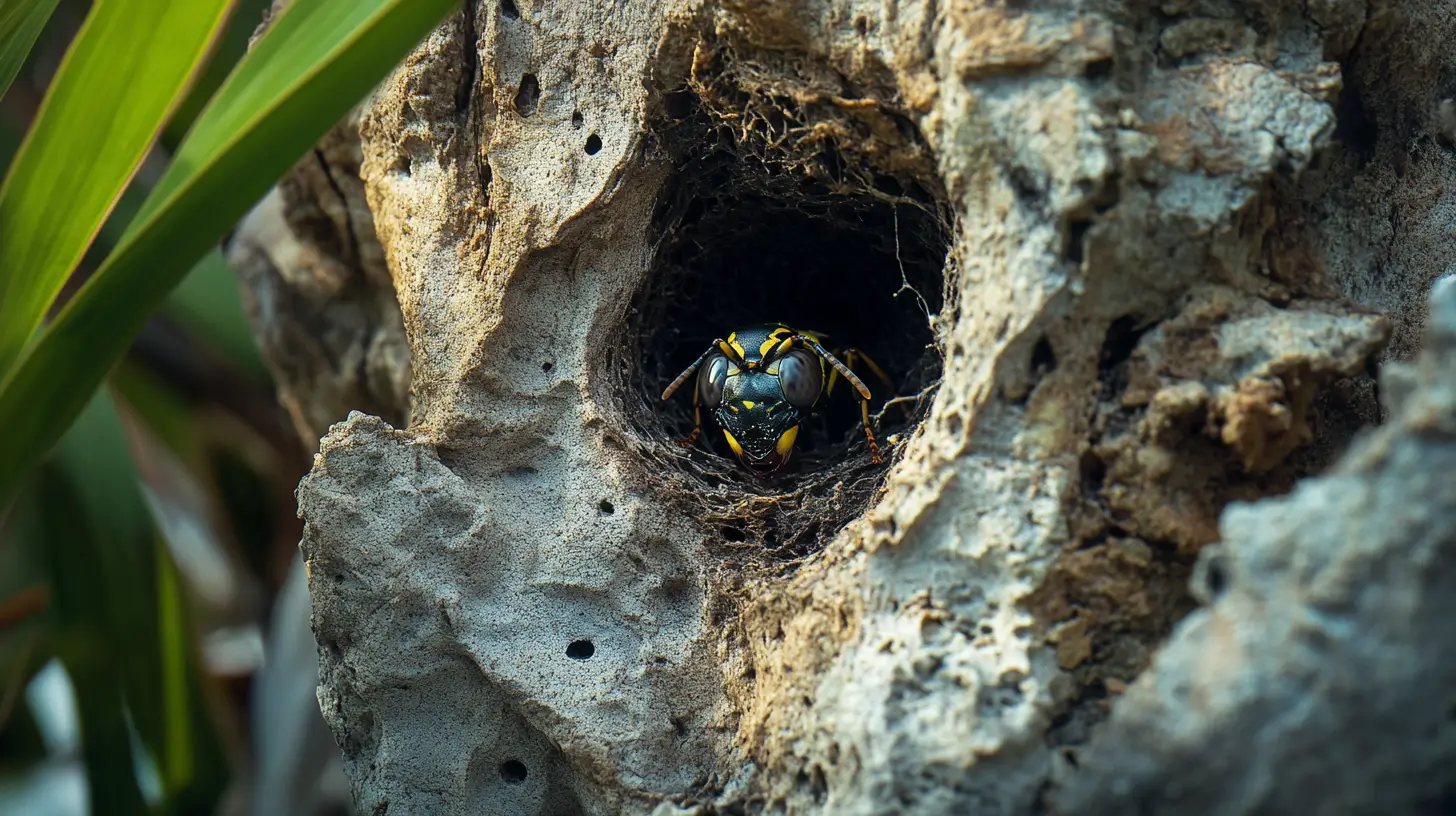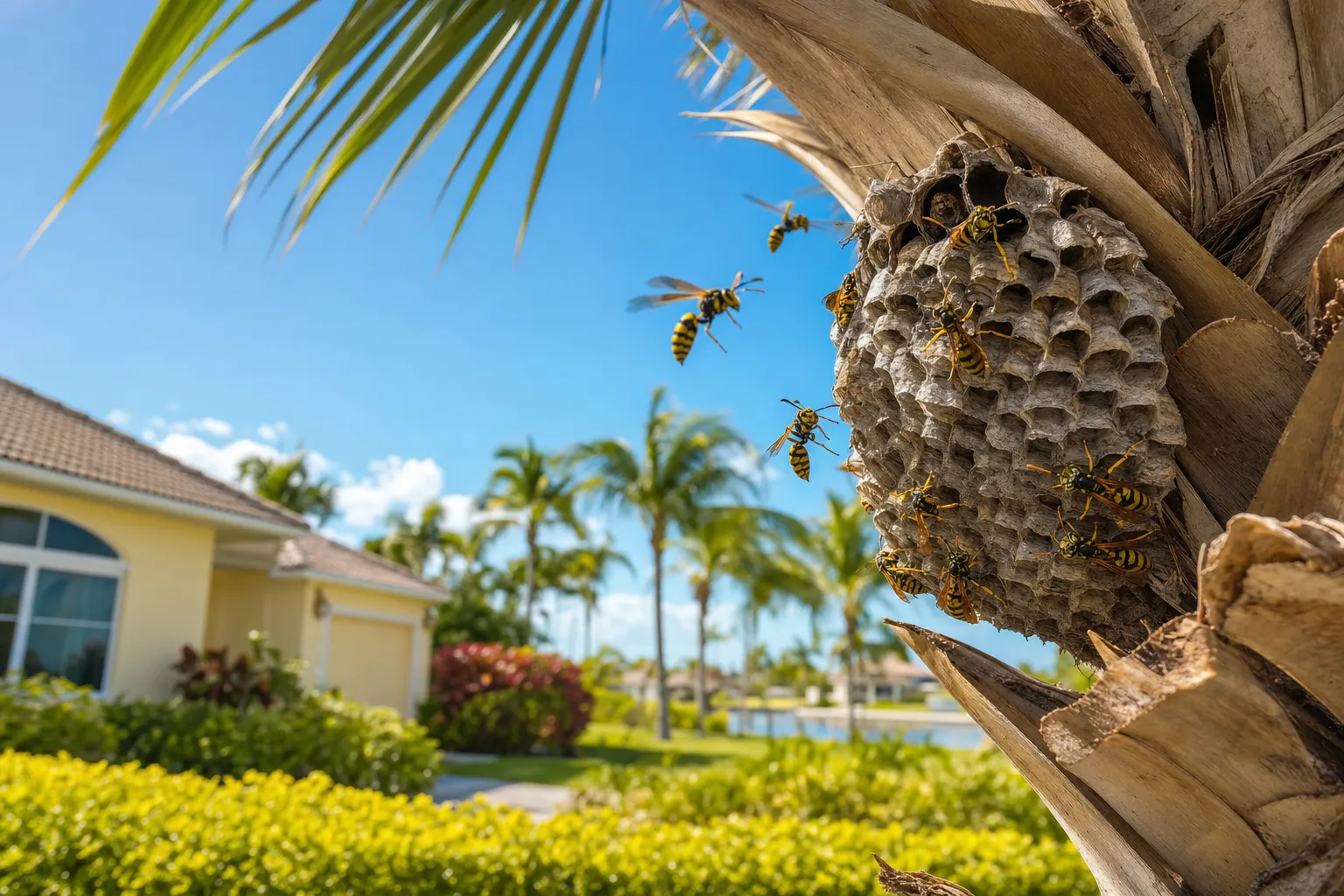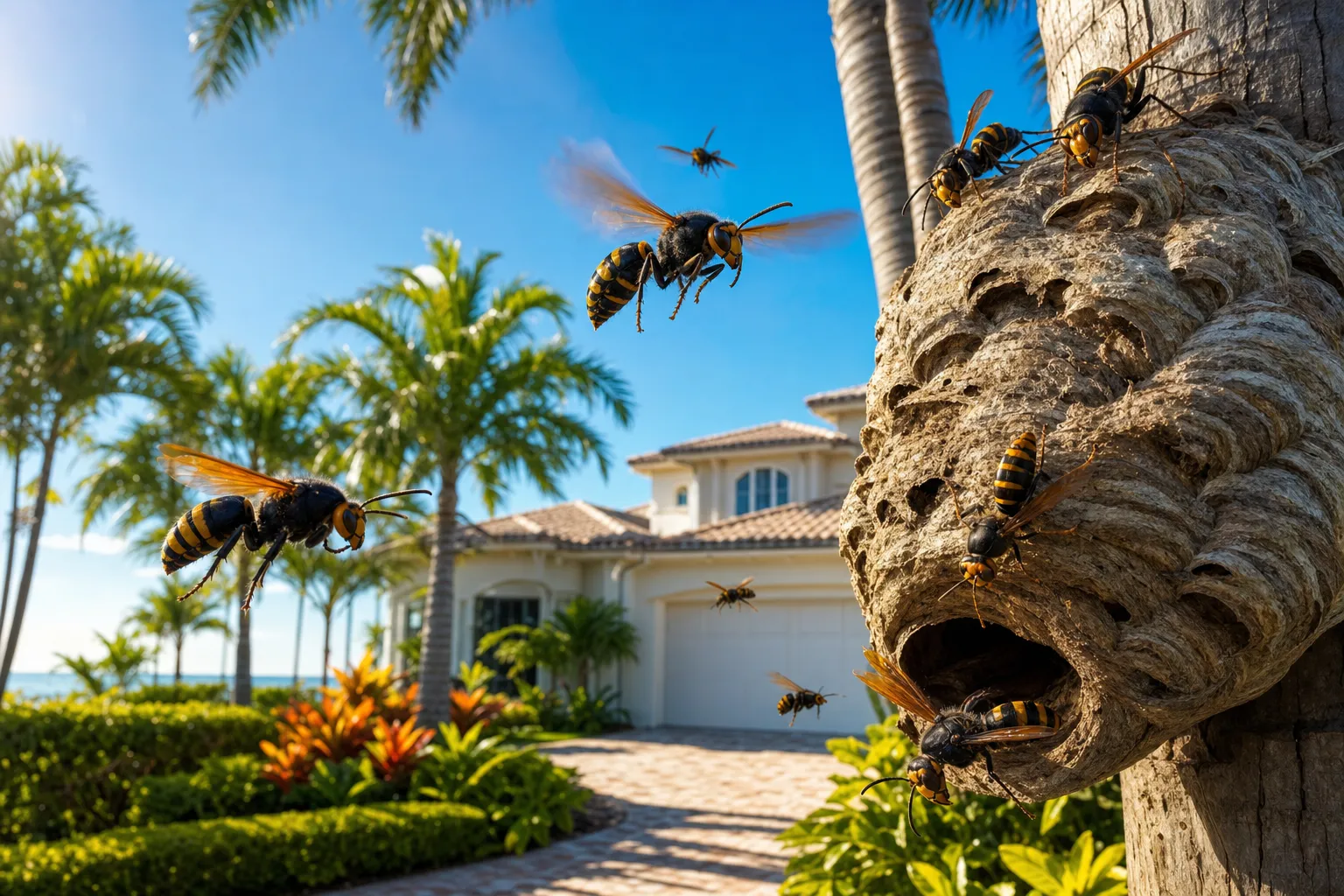
Dirt daubers get a worse reputation than they’ve earned. You spot that skinny, waspy thing troweling mud under your eaves, and your brain files it right next to the paper wasps that chase you off the patio. Good news for your nerves: a dirt dauber almost never stings.
Dirt dauber, mud dauber, mud wasp, they’re all the same solitary wasp with a mud habit. If you want the field guide on every wasp buzzing your Southwest Florida yard, our pest library sorts them out. This one’s about a single question. Do they sting, and should you care?
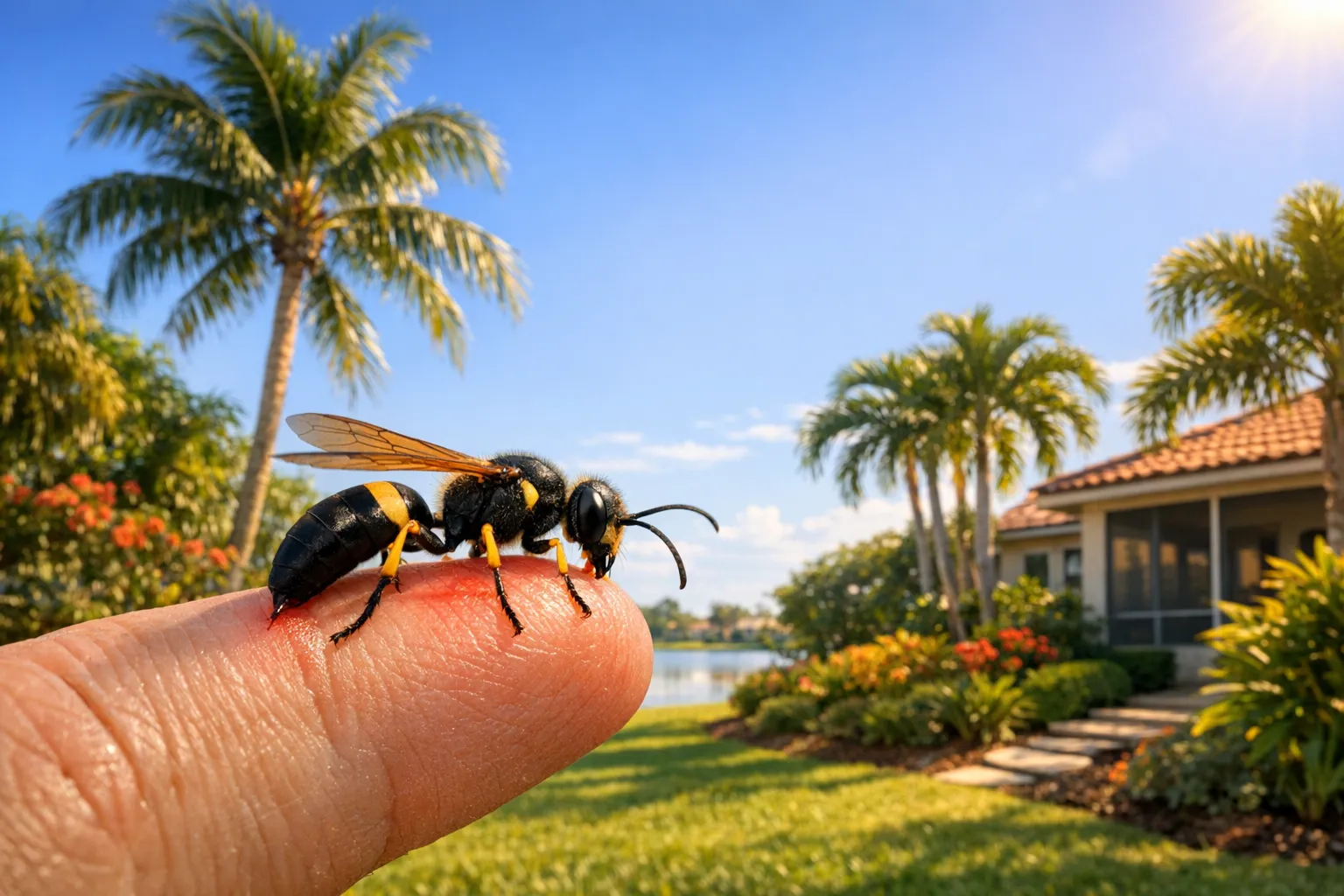
Short answer: yes, they physically can. It almost never happens, though, because a dirt dauber has no colony to defend and no real interest in you. A sting usually only lands when you trap one against your skin by accident. If it turns out you’ve got the wasps that do come after people, our pest control services page is the faster route to some quiet.
So do dirt daubers actually sting?
What makes a dirt dauber different from the wasps you swat at is simple. It’s solitary. One female builds her own mud nest, stocks it with food, seals it up, and moves on. There’s no hive full of sisters wired to swarm anything that wanders close. That colony-defense reflex is what turns yellowjackets and paper wasps mean, and daubers just don’t run that program.
So they mostly ignore you. You can stand a couple feet from a female packing mud and she’ll keep troweling. Daubers don’t guard territory the way social wasps do, and they won’t chase you across the yard. If something once ran you off your own patio, that was a paper wasp or a yellowjacket doing it.
Could one sting you? Sure, if you grab it, step on it barefoot, or reach blind into a spot where it’s tucked in. The sting is mild for a wasp. You’ll feel a sharp pinch, see some redness, and get localized swelling that fades over a few hours. A little itch or a welt might hang around for a day. Entomologists at UF/IFAS and other extension programs rate dauber venom as weak next to a lot of stinging insects.
Allergies are the exception. If you react badly to wasp or bee stings, any sting can get serious, dauber included. Spreading swelling, hives, trouble breathing, or dizziness after a sting is a 911 situation, not a pest-company call.
Is it a dirt dauber, or a wasp that means business?
Before you decide to shrug it off or call somebody, nail down what you’re looking at. Identification comes first, because the smart move for a docile dauber is the wrong move for a nest of yellowjackets.
Daubers give themselves away two ways: the bug and the build.
The wasp itself is slim, with a long thread-thin waist, usually black or a metallic blue, sometimes black with pale legs. The nest is the bigger giveaway, and it’s always mud. Organ-pipe daubers stack long parallel tubes that look like a little pan flute glued to the wall. Black-and-yellow daubers smear theirs into a smooth mud lump. If you’re looking at gray papery honeycomb or a football-shaped gray envelope, you’re not dealing with a dauber, and you’ll want to keep your distance.
On every inspection
Reading a dirt dauber (and its nest)
- Skinny thread-waist body Long, narrow connection between thorax and abdomen. Black, or a shiny blue, sometimes with pale legs.
- Mud tubes like a pan flute Organ-pipe daubers stack parallel mud tubes on walls, eaves, and under soffits.
- Smoothed mud lump Black-and-yellow daubers plaster theirs into a rounded blob the size of a golf ball or two.
- Solo flyer, no swarm One wasp working a nest, not a cloud of them defending it.
- Gray paper means back off Honeycomb combs or a football-shaped envelope point to paper wasps or yellowjackets, not a dauber.
Quick field cues. When the nest is gray paper instead of mud, treat it as a stinging wasp.
Still can’t tell? We put together a full Florida wasp identification walkthrough for this exact standoff.
Why Southwest Florida is dirt dauber paradise
Daubers want two things, and Southwest Florida hands over both. Mud and spiders.
Every afternoon storm that rolls off the Gulf leaves puddles and soft, damp ground behind it. Our sandy soil packs into workable mud in a hurry, which is basically free building material for a wasp with a trowel for a face. Stir in the warm, sticky air we get most of the year and the building season stretches long. Those same shady, humid corners and thick St. Augustine lawns that keep yards here green also keep spiders around, and spiders are what dauber larvae eat.
So their nests turn up under stucco eaves, on porch ceilings, inside sheds and garages, and in the still corners of a screened lanai from Bradenton down to Venice. Anywhere dry, sheltered, and a short flight from good hunting.
Activity tracks the heat. You’ll see the most nest-building through the thick of summer, and it eases back as fall cools off.
Seasonal pressure
Dirt dauber activity across the SWFL year
- Winter Dec-FebLower
Adults mostly gone; last summer's mud nests still stuck to the eaves.
- Spring Mar-MayBuilding
New females emerge and start scouting mud and spider-rich corners.
- Summer Jun-AugPeak
Nest-building runs hot through the humid, storm-soaked stretch.
- Fall Sep-NovActive
Provisioning slows as the heat eases, then tapers into winter.
Summer runs hottest. When you'll notice the most mud nests going up around a Southwest Florida home.
The dirt dauber is quietly working for you
Dirt daubers hunt spiders, and that works in your favor. A female stings her prey to paralyze it, packs the spiders into those mud cells, and lays an egg on top so the larva has fresh food waiting when it hatches. Blue mud daubers have a real thing for black widows.
So the lone dauber patrolling your porch is thinning out the spiders you’d rather not have near the kids and pets. Left alone in an out-of-the-way spot, it’s about as close to a helpful houseguest as a wasp gets.
Pro tip: If a dauber set up on a fence post, a shed wall, or some corner nobody touches, the low-drama play is to leave it through the season and scrape the empty nest off later. You get free spider patrol and skip the wrestling match.
What to do about a dirt dauber nest (and what to skip)
If the nest is somewhere you can’t just ignore, over a doorway, on the grill, right where you park, here’s the calm way through it.
Wait for evening or a cool morning when activity is low. Finished nests are usually empty, and you can scrape them off stucco or wood with a putty knife. They pop off cleaner than you’d guess. Knock the nest into a bag, toss it, and wipe the spot so the leftover mud smudge doesn’t advertise the address to the next wasp.
On the skip list: don’t stand there emptying a can of Raid into a mud tube. It’s messy and pointless on a wasp this calm, and if you’ve misjudged the nest and there’s a social wasp inside, you’ve just picked a fight you didn’t want. Don’t go reaching bare-handed into a nest you can’t fully see either, especially up high or in a dim shed corner.
Call a pro when the situation shifts. Somebody in the house allergic to stings, a nest that’s high or awkward to reach, daubers rebuilding in the same spot over and over, or a closer look that turns up gray paper instead of mud, any of those is a fine reason to hand it off. Not even sure it’s a dauber? Our fuller rundown on whether mud daubers sting walks through the worry-or-relax call.
Here’s how we run it at Waves. A tech confirms what you’ve actually got first, since the plan for a harmless dauber looks nothing like the plan for a defensive yellowjacket. We knock down and clear the nests, and for the wasps that genuinely sting, we treat the spots they favor with a professional product used according to its label. Clearing active nests and hitting their preferred corners cuts down how often new ones show up through the season, though no honest company is going to promise a wasp will never build near your house again.
Would rather not run wasp patrol every summer yourself? A recurring WaveGuard membership keeps a tech on your property on a set schedule, and if covered pests turn up between visits, we come back free, as many times as it takes. Want a sense of what any of this costs before you pick up the phone? Run your details through the pest control calculator.
The bottom line on dirt daubers
A dirt dauber is one of the few wasps you can mostly live and let live. It rarely stings and won’t chase you, and it earns its keep hunting spiders around your Southwest Florida home. Learn the mud nest, stay alert for the gray-paper lookalikes, and you’ve got this handled.
When a nest lands in a bad spot, or you can’t tell what’s living in it, let us sort it out. See what’s covered on our pest control services page and get a tech pointed your way.