Jump to a section (8)
- 01Quick answer: should you top dress your lawn with topsoil?
- 02What topdressing is and what UF/IFAS says it does
- 03Why the material has to match the soil you already have
- 04Low spots: the one job where adding sand makes sense
- 05What about compost?
- 06What actually makes St. Augustine thick and green
- 07What Waves Pest Control does and does not do
- 08Frequently Asked Questions
Spreading a load of topsoil over the lawn sounds like the shortcut to thicker, greener grass. On an established St. Augustine lawn sitting on sandy Southwest Florida soil, UF/IFAS guidance points somewhere else. This post walks through what topdressing is, what UF/IFAS says it does, the one job where adding sand makes sense, and where your effort pays off instead. For how a full lawn program works here, see our page on lawn care in Lakewood Ranch.
If you would rather have someone look at your lawn before you buy anything, request a lawn care quote.
Quick answer: should you top dress your lawn with topsoil?
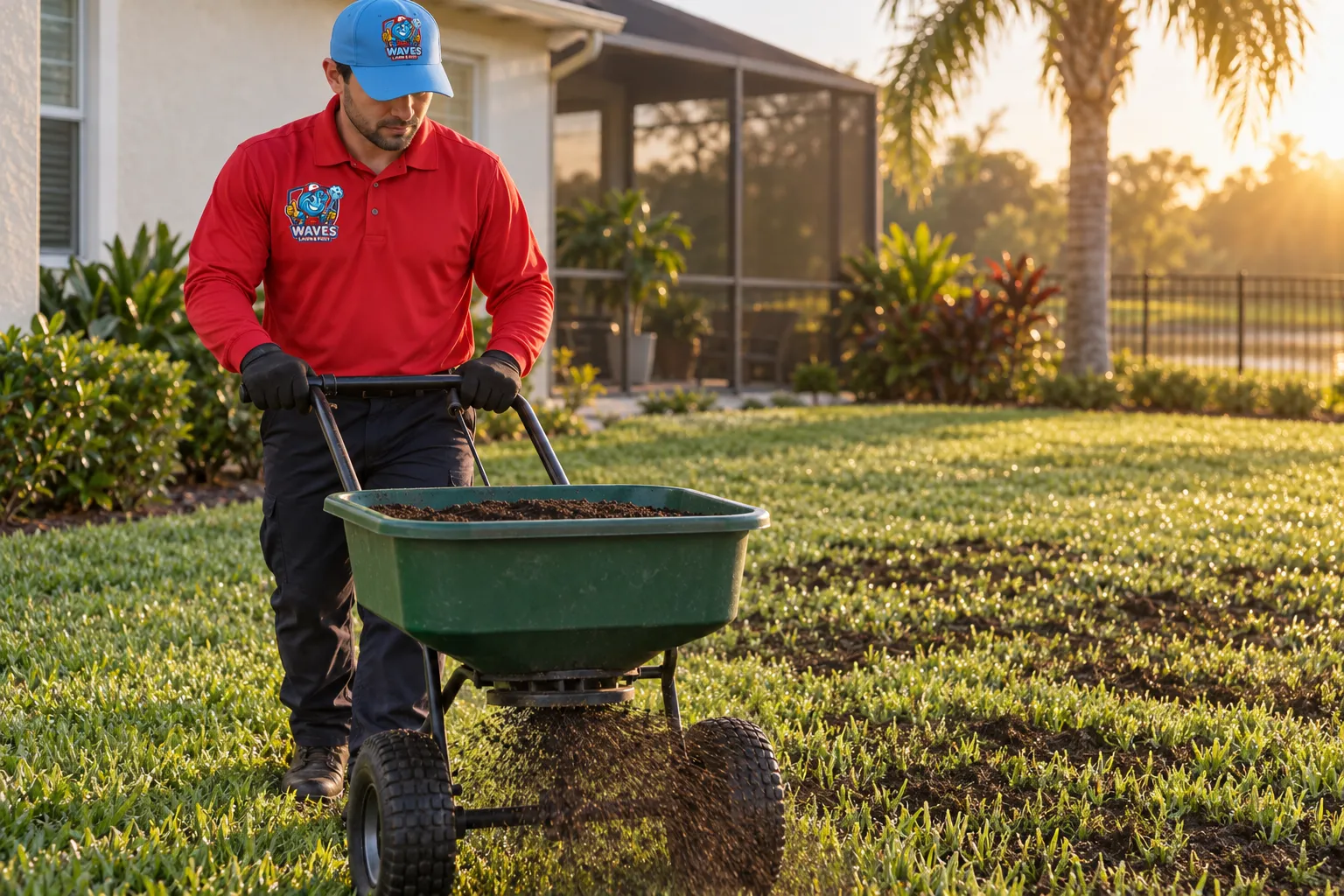
On an established St. Augustine lawn, skip the bagged or hauled-in topsoil. If you topdress at all, UF/IFAS describes about ¼ inch of weed- and nematode-free soil that matches the soil under the grass, used mainly to manage thatch. For color and thickness, put the effort into fertilization, mowing height, watering and pest checks.
What topdressing is and what UF/IFAS says it does
Topdressing means spreading a uniform, thin layer of soil over the top of the grass. The UF/IFAS St. Augustinegrass guide (ENH5, St. Augustinegrass for Florida Lawns, revised July 2024) describes periodic topdressing with ¼ inch of soil similar to the soil underlying the turf as a good method to ease thatch buildup.
The same guide adds two cautions. It says the physical labor involved limits how practical this is for most homeowners. It also says to use soil free of weed seeds and nematodes and to be careful not to exceed recommended topdressing rates.
A UF/IFAS turfgrass specialist puts it more bluntly. In a March 9, 2022 column, Larry Williams, a UF/IFAS Extension agent in Okaloosa County, quoted Dr. Bryan Unruh, University of Florida Extension turfgrass specialist: “Topdressing home lawns has minimal agronomic benefits.” Asked for his advice to homeowners on topdressing, Unruh’s reply was “don’t.”
Why the material has to match the soil you already have
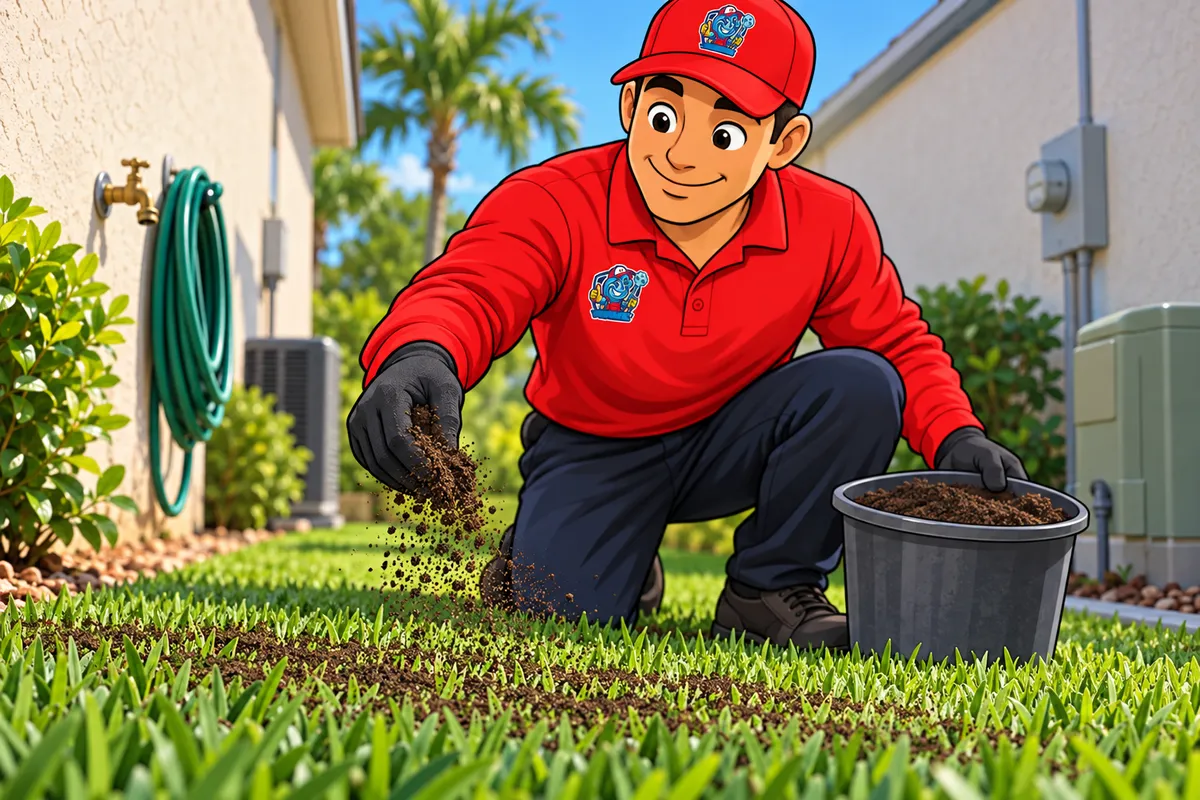
Topdressing soil has to match what is already under your grass. In his column, Williams writes that topdressing soil should be free of weeds and nematodes and should be the same soil type (texture) as the soil the turf is growing in. He also writes that routinely applying a layer of soil or sand to a lawn can cause more damage than good.
Most Florida soils are sandy, with little organic matter and low water- and nutrient-holding capacity, according to the UF/IFAS guide ENH02, Preparing to Plant a Florida Lawn. So a bagged or hauled-in topsoil of a different texture does not match what is underneath a typical lawn from Parrish to Venice.
Where the material comes from matters too. Williams warns that some sources of lawn dressing can bring in weed seeds, nematodes and even diseases, and that topsoil from an unknown source may introduce weeds that take extra work and expense to correct.
Low spots: the one job where adding sand makes sense
Minor low spots are the place where adding material earns its keep. Williams describes the method step by step:
- Shovel sand into the low spot, no more than about an inch or two deep.
- Keep mowing, watering and caring for the lawn normally until the grass grows up through that layer.
- Repeat until the low spot is filled.
He warns that it is easy to overdo it and smother the lawn, and that topdressing a lawn with sand on a regular basis is not a recommended practice.
Pro tip: spread the sand the same day it arrives. Williams describes sand piles that sit in one spot for days, shading out and often killing the grass below, until the lawn ends up dotted with small mounds.
What about compost?
UF/IFAS guidance on compost for lawns centers on working it into the soil before a lawn is planted. ENH02 says organic amendments such as compost can improve soil drainage and increase water- and nutrient-holding capacity, and that they should be tilled or mixed into the top 6 inches of soil during preparation.
For an established St. Augustine lawn, the UF/IFAS topdressing guidance in ENH5 describes soil similar to what is already under the turf.
What actually makes St. Augustine thick and green
These are the basics the UF/IFAS St. Augustinegrass guide (ENH5) lists:
- Fertilize on a Florida-Friendly schedule. ENH5 tells anyone fertilizing a lawn to follow the Florida-Friendly Landscaping Best Management Practices. Follow your county’s fertilizer rules too. Our Sarasota County fertilizer rule guide explains the local rules.
- Mow high. Standard St. Augustine cultivars should be mowed at 3.5 to 4 inches, with no more than one-third of the leaf blade removed at a time. Our mowing height guide lists heights by grass type.
- Leave the clippings. ENH5 says clippings left on a lawn mowed at the proper height and frequency do not add to thatch.
- Water as needed. Water when leaf blades fold, wilt or turn blue-gray, or when footprints stay visible after you walk on the grass. Let the grass tell you, whether or not the afternoon storms showed up this week. Our guide to overwatering vs. underwatering shows the signs.
- Check for chinch bugs. ENH5 calls the southern chinch bug the major insect pest of St. Augustinegrass. Our post on chinch bugs in Bradenton lawns covers how to check.
- Go easy on nitrogen. ENH5 says large patch is encouraged by excessive nitrogen. See our large patch guide for what it looks like.
What Waves Pest Control does and does not do
Our lawn program puts its effort into those basics: fertilization, weed control, and insect and disease checks on a set schedule. We do not add topsoil to lawns.
If your question is what that program would cost for your yard, request a lawn care quote through our contact page. In Lakewood Ranch, our lawn care in Lakewood Ranch page explains how the service works.
Frequently Asked Questions
Can I spread topsoil over my lawn to thicken it?
UF/IFAS turfgrass specialist Dr. Bryan Unruh says topdressing home lawns has minimal agronomic benefits. The UF/IFAS St. Augustinegrass guide lists fertilization, mowing height, watering as needed and pest checks as the basics of care.
Is sand or topsoil better for filling low spots?
For minor low spots, the UF/IFAS Extension column describes shoveling in sand no more than about an inch or two deep and repeating once the grass grows through. Any material you add should match the texture of the soil the grass is growing in.
How thick should a topdressing layer be?
The UF/IFAS St. Augustinegrass guide (ENH5) describes ¼ inch of soil similar to the soil under the turf. It also says not to exceed recommended topdressing rates.
Should I mix compost into the soil before laying new sod?
UF/IFAS describes compost and other organic amendments as a soil preparation step before planting. ENH02 says they can improve drainage and water- and nutrient-holding capacity when tilled or mixed into the top 6 inches of soil.
Will topdressing fix chinch bug or large patch damage?
For large bare areas, ENH5 describes replanting with sprigs, plugs or sod. Find the cause first, whether that is chinch bugs or large patch, then see our guide to plugging St. Augustine grass.